Saturday, February 24, 2007

ANTI-SEMITISM: IT'S THE GOSPEL


Mel Gibson and the Gospel of Anti-Semitism

by Charles Patterson


The trouble with Mel Gibson's film "The Passion" is not the film itself, but the gospel story on which it's based. The gospel story, which has generated more anti-Semitism than the sum of all the other anti-Semitic writings ever written, created the climate in Christian Europe that led to the Holocaust. Long before the rise of Adolf Hitler, the gospel story about the life and death of Jesus had poisoned the bloodstream of European civilization.

The four gospels — Matthew, Mark, Luke, and John (there were others, but they didn't make it into the New Testament) — were written decades after the death of Jesus. Not only were they not composed in Galilee where Jesus lived or in Jerusalem where he died, but they were not written in Aramaic, the language of Jesus and the region where he lived. Instead, they were written in Greek more than a generation later in cities in the Roman empire like Antioch, Ephesus, and in the case of the earliest gospel (Mark) in Rome itself. As a result, these gospels are at a considerable cultural, linguistic, and religious remove from the events they allegedly describe.

The historical Jesus (as opposed to the Jesus portrayed in the New Testament and elevated to divinity by the Christian church) was a Jew, faithful to the law of Moses and the teachings of the prophets. He grew up and worked in Galilee, where Jewish patriotism was intense, and he was steeped in Jewish scriptures, oral law, and the spirit of the Pharisees, the leading religious teachers of his day. People called him "Rabbi" and, like many religious Jews, he expected the imminent coming of the messianic era, or the "Kingdom of God," as he called it.

Like other religious, nationalistic Jews before and after him, Jesus (whose Aramaic name was Yeshua) angered the Roman government because of his preaching, which was considered dangerous. On what turned out to be his final Passover trip to Jerusalem, Jesus was arrested and, upon the order of the Roman procurator, executed.

After his death, his followers — most of whom were simple fishermen and artisans — lived on in Galilee and Jerusalem. Called "Nazarenes" after Jesus's hometown of Nazareth, they continued to observe Jewish laws and wait for the coming of the Kingdom of God, which Jesus had promised. In Jerusalem it was James, the brother of Jesus, who headed the Nazarenes for the next thirty years until he, too, was put to death in 62 C.E.

However, the future of Christianity did not remain long in the hands of these Aramaic-speaking Nazarenes. It passed on to an energetic, Greek-speaking Jew from Tarsus in Asia Minor by the name of Paul. He had never met Jesus and wasn't greatly impressed by the Nazarenes he did meet when he visited Jerusalem. What won Paul over to the belief that Jesus was the Christos (the Greek word for Messiah) was a vision. After his vision, Paul traveled all over the eastern Mediterranean preaching his own understanding of Christianity, which was rather different from the Nazarene version. Unlike the Nazarenes, who lived according to Jewish law in Jerusalem and Galilee, Paul took his message to gentiles as well as Jews. As a result of tireless work and extensive travel, he planted Christian congregations in Asia Minor and Greece.

The differences between Paul's teachings and those of the Nazarenes back in Jerusalem and Galilee soon became apparent. Not only did Paul preach to gentiles, but he also did not insist that these converts submit themselves to circumcision or to any of the other demands of Jewish law. The Nazarenes were outraged when they learned about Paul's negligence, and they summoned him to Jerusalem for an explanation. In Jerusalem before the Nazarene elders, Paul acted as a devout Jew, observing all the details of Jewish law.

Paul never changed his mind about his mission to the gentiles and his opposition to having these converts treated like second-class citizens. In letters he wrote to his churches (now collected in the New Testament), he went so far as to claim that the law of Moses was no longer necessary, even for Jews, and that faith in Christ and his teachings was sufficient. He also believed that everybody in the churches — Jews and gentiles, slaves and free persons — should be equal. When people from the Nazarene church in Jerusalem arrived at his churches to try to convince the gentile converts to obey Jewish law, Paul denounced them as "Judaizers."

The conflict between the Nazarenes and Paul that divided the early Christian movement was decided by a stroke of history. The Jewish-Roman War (66-70 C.E.), which destroyed Jerusalem and its temple and killed many Jews, dealt a devastating blow to the Nazarenes, from which they never recovered. Whatever traditions and writings they possessed were lost or forgotten. Instead, Paul's churches survived and became the basis for a Christianity that quickly became separate from and even hostile to the Judaism out of which it emerged.

By the time the Christian gospels were written in the latter part of the first century, Jews and Christians were fierce competitors arguing over whether or not Jesus was the Messiah-Christ promised in the Hebrew Bible, and over which group — Jews or Christians — represented the "true Israel." By the end of the first century resentment and mistrust of Jews were so widespread in the aftermath of the Jewish revolt against Rome that the young Christian churches in the cities of the empire sought to distance themselves from their Jewish roots.

This desire to dissociate explains why hostility toward Judaism and Jews came to be written into the gospels. They told the story of Jesus in such a way that it seemed as if his real enemies were not gentiles, or even the Romans who put him to death, but rather Jews — Pharisees, priests, and the Jewish people in general.

This anti-Jewish point of view is evident in the Gospel According to Mark, the first of the gospels written in Rome shortly after the end of the Jewish-Roman War in 70 C.E. when anti-Jewish resentment was especially strong in the capital. In Mark's gospel Jesus is persecuted at every turn by the Pharisees and priests of Judaism. In fact, the very first person in the gospel to recognize his worth was not a Jew at all, but a Roman centurion present at his crucifixion, who proclaimed, "Truly this man was a son of God" (Mark 15:39).

Likewise, Mark's gospel pictures Pontius Pilate, the Roman procurator who ordered Jesus's execution, as someone who tried his best to be nice to Jesus. According to Mark, Pilate wanted to have Jesus released but was prevented from doing so by a mob of bloodthirsty Jews (the same people who cheered his entrance into the city several days earlier). By telling the story in this way, Mark's gospel put the responsibility for the death of Jesus on the Jews, not on the Roman government that ordered his death.

Matthew's gospel took this blaming of the Jews one step further. In this gospel Pilate's wife warns her husband not to have anything to do with wronging "that righteous man." Then, after the Jewish mob shouts for the death of Jesus (choosing to have the criminal Barabbas released instead), Pilate washes his hands in front of the crowd, saying "I am innocent of this man's blood." Here Matthew puts into the mouths of the crowd words that were to condemn later generations of Jews: "And the people answered, 'His blood be on us and on our children!" (Matthew 27:25).

The other two gospels — Luke and John — also portray Jews and Judaism as forces that persecuted Jesus and drove him to his death. Combined with the letters of Paul, these four anti-Jewish gospels make up the bulk of the New Testament, which Christianity considers to be a sacred and accurate account of history.

Not surprisingly, this negative picture of Judaism and the Jews continued in the writings of the Christians who followed. The fourth-century bishop of Antioch, John Chrysostom, widely respected as a "Doctor of the Church" and later canonized as a saint, preached fiery sermons against the Jews of his city, calling them "lustful, rapacious, greedy, perfidious bandits...inveterate murderers, destroyers, men possessed by the devil." Their synagogue was a place of "shame and ridicule," and Jewish religious rites were "criminal and impure." Why were the Jews so hateful? The answer, said Chrysostom, was in the gospel story: the Jews were hateful because of their "odious assassination of Christ."

In the Middle Ages the gospel story about the "assassination of Christ" was enacted annually in Passion plays staged outdoors at Oberammergau in Germany and many other places in Europe. These plays — forerunners of the Gibson film — enacted for their audiences the passion (suffering) of Jesus in all its gory details.

It is ironic and tragic that Christianity, which began as a Jewish sect, grew up to become such a dangerous threat to Judaism. To their credit, some post-Holocaust Christians have been trying to come to terms with the church's anti-Semitic past and get beyond it. In the early 1960s the Catholic Church's Vatican II pronouncement denounced anti-Semitism and stated that Jews of the past, as well as the Jews of today, bear no responsibility for Jesus' death. It was definitely a long overdue step forward, but this film has dealt a serious blow to these efforts.


Source: Reprinted by permission of the author. Patterson is author of Anti-Semitism: The Road to the Holocaust and Beyond.

Wednesday, February 21, 2007

Persian Empire UK Style.

We assigned Basra to the UK, because it was a British Colony, because Shi'a can count, and know who Iraq goes to in 'elections', and why fight the outsiders when you've already won? So now they leave, and the media wonders if it will be like the rest of Iraq, under U.S. authority? A bit of intraShi'a violence, sure. But nothing to be learned here except that the inventors of the zero can count. We fight on for the Islamic Republic of Iraq, a frachise of Iran, Inc., purveyors of Islamic Fascism since 1979. Henry_Allen

Sunni Woman's Rape Claim Roils Iraq
BAGHDAD, Feb. 21, 2007 (CBS/AP) An Iraqi Sunni woman who leveled rape allegations against three members of the Shiite-dominated security forces was taken to a U.S.-run medical facility over the weekend, the chief U.S. military spokesman said Wednesday.

But Maj. Gen. William B. Caldwell refused to disclose details of her medical treatment or examination, citing privacy issues.

"What I can tell you is that at a point on Sunday evening, an Iraqi woman was brought to our medical facility. She was put under the care of our medical personnel there and sometime early Monday morning she was released," he said.

The revelation has stunned Iraq, where rape is rarely discussed in public — much less by the victim herself on a prominent television station. With Shiite leaders calling her charges propaganda and Sunni politicians offering the woman support, the disclosure has threatened to worsen sectarian violence.

The 20-year-old Sunni woman said she was assaulted Sunday at a police garrison where she was taken on suspicion of helping Sunni insurgents. Prime Minister Nouri al-Maliki's office Wednesday released what it said was a medical report issued by Ibn Sina hospital indicating no signs of rape.

The report, in English, was e-mailed to news organizations by al-Maliki's office. The grainy document was marked as page two of three and did not have the name of the patients or any of her personal details. A handwritten note in English said she had no bruises or injuries.

Caldwell said the Americans had not released any information about the case out of respect for patient privacy.

"She was released with her medical records. What she does with those is her own decision," he said.

Caldwell also told reporters that Gen. David Petraeus, the top U.S. commander in Iraq, has ordered a probe into the case and appointed an investigating officer who already has begun collecting information on the allegations, made in interviews broadcast Monday by several Arab satellite TV stations.

"Once the Iraqi government makes a decision on how they are going to move forward (and) there is an investigating judicial process established and they need this information from us, we will make that readily available to them," he said.

In other developments:

# A U.S. helicopter that crashed Wednesday north of Baghdad was shot down, the military said, reversing its initial statement that the chopper made a "hard landing." Military spokesman Lt. Col. Christopher Garver said all the occupants were safely evacuated by a second helicopter.

# British Prime Minister Tony Blair on Wednesday announced a new timetable for the withdrawal of British troops from Iraq, British media reported. About 1,600 are to leave the south of Iraq within "several months", and Blair said some of the remaining 5,500 soldiers could be pulled out before the end of the summer

# A suicide car bomber struck a police checkpoint Wednesday in the Shiite holy city of Najaf, killing at 13 people in the spiritual heartland of the militia factions led by radical cleric Muqtada al-Sadr. The Najaf blast hit while streets were filled with morning shoppers. At least two of the victims were police and the rest civilians, authorities said. It was the first major bombing in months in the city, which is heavily guarded by police and al-Sadr's powerful Mahdi Army militia.

# A U.S. Marine was killed in fighting in the volatile Anbar Province and a soldier was killed by gunfire in a neighborhood of Baghdad, the military said Wednesday. The Marine assigned to Multi-National Force — West was killed Tuesday during combat operations in the insurgent stronghold, which stretches west from Baghdad to the borders with Syria, Jordan and Saudi Arabia, according to a military statement. The soldier was hit by small arms fire in a northern district of Baghdad on Tuesday, a statement said.

# U.S. forces were investigating the "hard landing" of a Black Hawk helicopter north of Baghdad. Caldwell said the airmen were picked up by rescuers, but gave no further details. At least seven U.S. helicopters have crashed or been forced down by hostile fire in the past month, killing 28 troops and civilians.

# A second U.S. soldier has pleaded guilty to the gang rape and murder of a 14-year-old Iraqi girl and the killing of her family, saying he held the girl down and acted as a lookout while others took turns attacking her. Sgt. Paul E. Cortez, 24, pleaded guilty to four murders, rape and conspiracy to rape. Cortez said he conspired with three other soldiers — Pfc. Jesse V. Spielman, Spc. James P. Barker and Steven D. Green, who has been discharged — to rape Abeer Qassim al-Janabi. If the judge approves the deal, Cortez could avoid the death penalty.


Caldwell's comments came hours after al-Maliki fired a top Sunni official who had called for an international investigation into the rape allegations. He also has exonerated the three Iraqi policemen accused by the woman and said they should be rewarded as a sign of confidence in the force.

A separate statement by al-Maliki's office gave no reason in announcing the dismissal of Ahmed Abdul-Ghafour al-Samaraie, head of the Sunni Endowment. Al-Samaraie, whose organization cares for Sunni mosques and shrines in Iraq, had joined other prominent Sunnis in criticizing the government's handling of the case.

Al-Samaraie, speaking from Amman in neighboring Jordan, disputed al-Maliki's right to fire him, arguing that only the country's Presidential Council — which comprises President Jalal Talabani and his two deputies — has that authority. A statement by the Endowment, which has offices across the country, said it rejects al-Samaraie's dismissal and declared an indefinite protest at its offices to protest the move.

His dismissal was the latest move in a highly publicized and increasingly bitter tussle over the rape allegations, pitting al-Maliki's Shiite-dominated government against its Sunni Arab critics. The public quarrel is fueling charges by the Sunnis that a Baghdad security crackdown was targeting Sunni neighborhoods and leaving unaffected Shiite areas harboring militias blamed for sectarian killings.

Al-Maliki has said the woman's allegations were being used by his critics to discredit the security forces and undermine the U.S.-Iraqi security sweep under way.

Al-Samaraie, the senior Sunni official, said in a statement Monday that the rape allegations offered what he called proof of the failure of the security push in Baghdad to protect the city's residents.

"The Sunni Endowment strongly denounces this horrific crime and lets out a cry for help from the international community and human rights organizations, demanding that they launch an immediate investigation into this crime," said the statement, signed by al-Samaraie.

Speaking to Al-Arabiyah television Wednesday, he said, "Many girls are raped but they refuse to appear in the media so as not to tarnish their reputations," he said. Later, he told Al-Jazeera: "We will continue to speak with courage and we will not fear anyone but God and I am not concerned about losing my job because the honor of Iraqi women is a thousand times more valuable than government jobs."

Also Wednesday, an Iraqi military spokesman suggested that the woman was helping Sunni insurgents in the western Baghdad Amil district where she lives, saying that security forces had more than once found her preparing large amounts of food during previous raids.

Brig. Gen. Qassim Moussawi said at a news conference the woman was questioned for only 15 minutes and that the house from which she was taken into custody had an "opening" that led to a small clinic where large amounts of medicines allegedly used to treat wounded "terrorists" were found.

He said the scandal surrounding the rape allegations was a result of coordinated efforts by groups inside and outside the country that were "known to be hostile to Iraq and its people," implying it was a publicity stunt engineered by critics of al-Maliki's government. First word of the rape allegations first came Sunday from parliament's largest Sunni Arab bloc, the National Accordance Front.


© MMVII, CBS Interactive Inc. All Rights Reserved.

Monday, February 19, 2007

MARS ATTACKS L.A. (REALLY!)

MARS BY WAY OF TOKYO!


THE 1942 UFO BATTLE OF LOS ANGELES


Here are two stories about the WW II UFO that set L.A. into an 'Orson Wells'

frenzy...with good reason. For an excellent analysis, see

http://www.rense.com/general27/battle.htm. For the Wiki whacky view see

http://en.wikipedia.org/wiki/West_coast_air_raid. Wikipedia isn't quite the

'open-source' cyclopedia they'd like to see themselves as. Henry_Allen

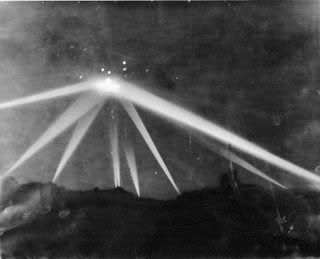
According to reports in the Los Angeles Times, on Wednesday, February 25, 1942,

an unidentified craft hovered over the city of Los Angeles. This event, dubbed

the “Battle of Los Angeles,” was witnessed by hundreds of thousands of residents

of the area. Spotlights, intent on spotting Japanese aircraft, played over the

motionless craft. The military lobbed almost 2,000 rounds of high explosive

shells at the floating sphere. Unscathed, the hovering UFO leisurely moved off

to the south and disappeared over the ocean south of Long Beach. Six civilians

were killed, others injured -- the results of shells fragments.

(Not reported to the public was the recovery of two aircraft -- one off the

coast of California, the other in the San Bernardino Mountains -- which

according to secret intelligence sources were in all probability of

interplanetary origin. These findings were sent to President Roosevelt by

General George C. Marshall who subsequently ordered a "thorough investigation of

all War Department files regarding unconventional aerial phenomenon reprted

since 1897..." Courtesy Ryan S. Wood, MAJIC EYES ONLY)


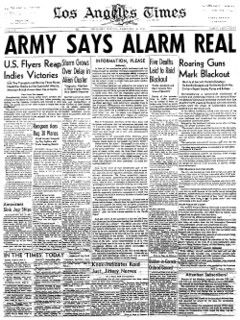
The following day, the Los Angeles Times reported the incident on page one:

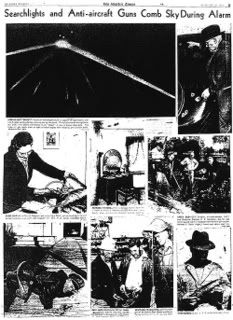
Below is an inside page from the Los Angeles Times, February 26, 1942.

No national media carried this story. For details go to:

http://www.rense.com/ufo/battleofLA.htm & MAJIC EYES ONLY by Ryan S. Wood

1942-Battle of Los Angeles
From Billy Booth -

Summary: It is very rare that among the annals of Ufology there should appear a

UFO case which involved military, yet is accompanied with actual photographic

proof. Such is the case of an event which took place over the Los Angeles area

on February 25, 1942. A giant UFO would actually hover over the city, and be

witnessed by hundreds of observers.

Pearl Harbor Scare: As America was gathering its senses after the shocking

attack on Pearl Harbor in December, 1941, there was a heightened feeling of

insecurity and anxiousness. The skies were being watched as never before as a

giant UFO moved through California, alerting the military and civilian watchers

as well. This case is known as the "Battle of Los Angeles," and is one of the

most important cases in Ufology.

Surreal Sight: It would be early morning on February 2, 1942 when the incoming

craft sirens were first heard in the Los Angeles area. Many Americans were

expecting another wave of Japanese fighter planes, and thought this is what they

would see as they left their homes, and ventured outside. How wrong they were!

The first sightings of a large UFO would be made in Culver City, and Santa

Monica.

A Total Blackout: Air Raid Wardens were ready to go at the first hint of an

invasion. But, this invasion would be something other than Japanese planes. The

giant hovering object was soon lit up by the gigantic spotlights of the Army's

37th Coast Artillery Brigade. Everyone who looked up was shocked by the sight of

the giant UFO sitting above their city. Military aircraft were sent to confront

the object.

UFO Takes Direct Hits: Because of a well-organized alert system, the whole

California southern section was searching the night skies in a matter of

minutes. What they saw were beaming searchlights illuminating the night sky, all

of them converging on one thing-a UFO. A similar scene would be repeated later

during the The Norwood Searchlight Incident albeit, on a smaller scale. The

beams of light would soon be accompanied by tracer fire from anti-aircraft

artillery, all of the rounds aiming at the invading craft. The giant UFO would

take direct hit after hit, yet without damage.

Hanging Magic Lantern: The 37th Brigade was relentless in its attempt to bring

down the large object, but found no success. The barrage of spent shells would

fall over the entire area-no place was safe this night. Many were injured, and

there were even reports of death from the falling shells. According to newspaper

reports, eyewitnesses described the sight of the UFO like a "surreal, hanging,

magic lantern."

Classic Photograph Taken: As the large UFO moved into more lighted areas, view

of the object became better. It moved directly over the MGM studios in Culver

City. Fortunately, an extremely good quality photograph was taken of the object

-beams attached, tracer fire visible. This photograph has become a classic UFO

photograph. The UFO would soon move over Long Beach before disappearing

altogether.

Woman Air Raid Warden Gives Testimony: Woman Air Raid Warden Gives Testimony:

"It was huge! It was just enormous! And it was practically right over my house.

I had never seen anything like it in my life!" she said.

"It was just hovering there in the sky and hardly moving at all. It was a lovely

pale orange and about the most beautiful thing you've ever seen. I could see it

perfectly because it was very close. It was big!"

More Eyewitness Testimony: "They sent fighter planes up and I watched them in

groups approach it and then turn away. There were shooting at it but it didn't

seem to matter."

"It was like the Fourth of July but much louder. They were firing like crazy but

they couldn't touch it."

"I'll never forget what a magnificent sight it was. Just marvelous. And what a

gorgeous color!" she said

The Guns Fall Silent: The giant invading airship was now gone, and the citizenry

of the southern California area began to resume normal activities. This was an

extremely important event-one that will not be forgotten.

Only the news of the war kept this from becoming a major news event. This case

must have been in the mind of President Ronald Reagan when he warned us of an

"alien threat, from outside of our world."

Are we ready?

Sunday, February 18, 2007

SOME of the Death Squads

Death Comes To Baghdad Despite Crackdown
Feb. 18, 2007(CBS/AP) Militants struck back Sunday in their first major blow against a U.S.-led security clampdown in Baghdad with car bombings that killed at least 63 people, left scores injured and sent a grim message to officials boasting that extremist factions were on the run.

The attacks in mostly Shiite areas — twin explosions in an open-air market that claimed 62 lives and a third blast that killed one — were a sobering reminder of the challenges confronting any effort to rattle the well-armed and well-hidden insurgents.

Instead, it was the Iraqi commanders of the security sweep feeling the sting.

Just a few hours before the blasts, Lt. Gen. Abboud Qanbar led reporters on a tour of the neighborhood near the marketplace that was attacked and promised to "chase the terrorists out of Baghdad." On Saturday, the Iraqi spokesman for the plan, Brig. Gen. Qassim Moussawi, said violence had plummeted by 80 percent in the capital.

Prime Minister Nouri al-Maliki condemned the bombings as a desperate act by "terrorists" and "criminals" who sense they are being squeezed.

"These crimes confirm the defeat of these perpetrators and their failure in confronting our armed forces, which are determined to cleanse the dens of terrorism," al-Maliki said in a statement.

U.S. military chiefs have been much more cautious. They have insisted the security drive, begun last week, may take months to make clear gains and that counter-punches from militants were likely every step of the way.

The ones dealt Sunday came from the militants' favored weapon of the moment: parked cars rigged with explosives.

The first blast tore through a produce market in the mostly Shiite area of New Baghdad, toppling the wooden stalls and leaving pools of blood and vegetables trampled in the chaos. Minutes later, another car bomb exploded near a row of stores.

More than 125 people were injured, including many women who were shopping, said police and rescue officials who spoke on condition of anonymity because they are not authorized to speak to the media.

Victims were carried to hospitals on makeshift stretchers or in the arms of rescuers.

Another car bomb in the Shiite enclave of Sadr City left at least one dead and 10 wounded, police said.

It was by far the deadliest day since the security sweeps began. On Thursday, a string of car bombs killed seven civilians on the first full day of the house-to-house searches for weapons and suspected militants.

The U.S.-led teams have faced limited direct defiance as they set up checkpoints and comb neighborhoods. But that could change as they move into more volatile sections of the city. The next could be Sadr City, a stronghold of the Mahdi Army militia loyal to radical Shiite cleric Muqtada al-Sadr.

U.S. soldiers pressed closer to Sadr City on Sunday and the reception changed noticeably. In previous days, Shiite families opened their doors to welcome the troops — feeling that the American presence would be a buffer against feared attacks from Sunni militia.

On Sunday, in areas closer to Sadr City, parents slapped away the candy and lollipops given to children by soldiers.

"The Baghdad security plan is very important to push Iraq ahead," said Haider al-Obeidi, a parliament member from the Dawa party of al-Maliki.
In other developments:

# Two more U.S. soldiers have been killed in action, the U.S. military said. Both were killed Saturday: one by a grenade in a northern neighborhood of Baghdad; the other from gunfire north of the city, the military said.

# As of Sunday, at least 3,137 members of the U.S. military have died since the beginning of the Iraq war in March 2003, according to an Associated Press count. The figure includes seven military civilians. At least 2,514 died as a result of hostile action, according to the military's numbers.

# Syrian President Bashar Assad held talks with Iranian leaders in Tehran, including President Mahmoud Ahamedinejad. The two leaders are generally on opposing sides of Iraq's sectarian divide: Iran backs the majority Shiites, and Syria is seen as a key supporter of Sunnis.

# Iran's Foreign Ministry denied that radical Iraqi Shiite cleric Muqtada al-Sadr was in Iran, calling statements by U.S. and Iraqi officials saying he had traveled to Iran "psychological warfare."

# A Marine who said he never fired a shot in the kidnapping and murder of an Iraqi man was sentenced Saturday to 8 years in military prison – the longest sentence yet in the case. Lance Cpl. Robert B. Pennington, 22, also was reduced in rank and given a dishonorable discharge during the sentencing hearing at the Camp Pendleton Marine base.

# CBS News reporter Kristen Gillespie visited a refugee camp in the Jordanian desert where a group of Iraqi refugees have lived three years in canvas tents. They can't go home, and their Palestinian ancestry makes for a very uncertain future.
(AP)
The Baghdad crackdown has sent ripples through all corners of the country. The borders with Iran and Syria — shut for three days as the plan got under way — reopened Sunday. But new and strict rules will apply.

Moussawi, the plan's spokesman, was quoted in the Azzaman newspaper as saying the crossing points to the two nations would be open for only several hours a day and under "intense observation."

The United States and allies claim Iraqi militants receive aid and supplies from Iran, including parts for lethal roadside bombs targeting U.S. forces. Iran denies any role in trafficking weapons.


© MMVII, CBS Interactive Inc. All Rights Reserved.

ANTI-SEMITISM UKRAINE NOW!

Torah scrolls confiscated
from Ukrainian community
By Vladimir Matveyev
KIEV (JTA) — As their Torah scrolls were packed into black plastic garbage bags and carried out of the Jewish school, the students and adults continued to pray, many with tears in their eyes.

The scrolls originally belonged to the Jewish community of Zhitomir in central Ukraine, but were acquired by the local state archives through communist and Nazi looting. Since then, in the absence of a restitution law, the archives had lent the scrolls to the community — but on shaky terms.

On Feb. 14, the community was forced to return 10 scrolls it had received more than two years ago. Representatives of the archives carried them out of the Ohr Avner Jewish Day School, leaving the community without any scrolls.

“This was like the medieval times, this was like a nightmare,” said Oleg Rostovtsev, a spokesman for the Federation of Jewish Communities of Ukraine, the country’s leading Jewish umbrella group.

The seizure was the result of a controversy that was triggered a few months ago when the officials at the Zhitomir Regional State Archives demanded the return of the scrolls, citing concern over their safety.

In 2004, the archives handed over 17 out of 290 Torah scrolls in its possession to be used by the local Jewish community run by Chabad.

The scrolls had been the property of the many synagogues and private Jewish households in Zhitomir, and were confiscated by communist authorities during anti-religious campaigns or seized by the Nazis during the occupation of Ukraine in World War II.

For two-and-a-half years, the scrolls were kept in a specially designated room at the Ohr Avner school.

Without a restitution law, many Jewish communities in the post-Soviet Ukraine were allowed to temporarily use Torah scrolls confiscated by the Bolsheviks, while most of the scrolls remain the property of state-run museums and archives.

Such loans do not always satisfy the Jewish community.

The Zhitomir community had previously expressed its concern that in the absence of a proper restitution act, they could not repair the borrowed scrolls in accordance with Jewish law.

In addition, representatives of the community had to submit a petition every three months that would allow them to keep the scrolls.

In October, representatives of the archives checked the scrolls kept in the Zhitomir school and demanded their return, claiming that at least seven of the scrolls may have been damaged while in the community’s possession.

Archive Deputy Director Natalia Shimchenko told JTA that the archive’s curators had established that the “number of units” registered with the archives “did not correspond with those in the community safe.”

Local Jewish leaders deny the accusations of improper care or alterations and said the scrolls — some of them fragmented — were improperly catalogued in the archives.

But the community chose not to argue, and last month returned the seven scrolls in question to the archives.

The archives then refused to prolong the loan agreement on the remaining 10 scrolls and confiscated them Wednesday despite protests from the Jewish community and the local governor.

“We are law-abiding citizens of Ukraine and we have not violated any laws,” community leader Vladimir Rozengurten said, adding that allegations of improper care and damage were “slander.”

“The statements that we have damaged the scrolls are outrageous,” Zhitomir Chief Rabbi Shlomo Wilhelm said. “This is a groundless accusation, and we still have no results of the examination” of the scrolls.

But community leaders said they had to back off, apprehensive of possible use of force by representatives of the archives.

“I’m sure we are not saying goodbye for a long time to the Torah scrolls,” Rozengurten said.

He and other community leaders are hoping that legislation will be adopted in Ukraine dictating the return of the scrolls that were confiscated by the Bolsheviks and the Nazis.

Saturday, February 17, 2007

UFO EASTERN EUROPE**2007**

Strange Lights, Reports are coming from Eastern Europe, such as this one, posted today. We will continue to document these reports. Henry_Allen


Hole in the ice fuels speculation about UFOs

Riga - A hole in a frozen pond in northern Latvia achieved unexpected notoriety on Wednesday as rumours began circulating that it was created by an object falling from outer space.

"We've been collecting information on the story all day, and we'll definitely report it in the morning," Inguna Plume, editor of local newspaper Ziemellatvija, told reporters.

The "unusually large hole" appeared in the ice of a frozen pond near the northern Latvian village of Karki in early February, the Leta news agency wrote. Despite sub-zero temperatures, the hole
reportedly did not freeze over for two days.

Locals initially reported seeing "strange things" in the area.

One girl said that she had seen "a small bright object with a silver ring around it", while other witnesses reported seeing up to six symmetrical beams of light emerging from the pond.

When the existence of the mysterious hole became known, the theory that it could have been created by an object falling from outer space began to gain credence, Karki spokesperson Sandra Pilskalne told Leta.

Scientific experts admit that the hole could have been created by a falling piece of interstellar debris, the news wire added.

The mysterious hole has now frozen over, but water samples have been taken for testing, Pilskalne said. Representatives of Karki council were not available for comment when approached by reporters. - Sapa-dpa

Quickwire

Published on the Web by IOL on 2007-02-14 23:14:25
© Independent Online 2005. All rights reserved. IOL publishes this article in good faith but is not liable for any loss or damage caused by reliance on the information it contains.

Sangre Eterna

Teen bloodsucking orgy!

>> Chilean director Jorge Olguin brings his unique vampire feature Sangre Eterna to Fantasia


by MATTHEW HAYS

Just when you thought that vampire fixation of yours had been sucked dry, a cool Chilean director has arrived to paint the cinema red all over again. And the blood has never tasted better - or looked better, for that matter.

With his latest feature, Sangre Eterna, Jorge Olguin has taken the well-trodden turf of teens bitten by the vampire bug and given it a new, funny and alternately seriously disturbing twist. Fantasia freaks will recall that Olguin's feature debut, Angel Negro, screened at the festival's 2001 edition. His wacky universe is wound up again on the big screen, and here, he's managed to give the vampire genre a good, sharp bite in the neck.

Sangre Eterna opens with apparently sweet, innocent Carmilla showing off her new goth look to her high school buddies. Carmilla finds herself straying from her usual group of straight friends and falling in with the goth crowd, finding herself sexually drawn to the leader of the goth pack, M. She's soon drawn into their vampire role-playing game, in which four sexy teens dredge up various fantasies about battling vampire hunters. It all seems so real, the fights in which bullets slice into our dear vampire friends like so much gunfire in an over-the-top Peckinpah Western. And the vampire hunters are closing in! Who will get out and survive and who will be hunted down for the cruel bloodsuckers they really are? It sure helps that the vampire goths, male and female, are sexy and alluring (funny how that works).

Olguin manages some truly dark comic touches up until this point, but then the movie takes one of those beautiful about-faces, morphing into something quite different. Taking its cues from George A. Romero's occasionally-overlooked Martin, Sangre Eterna has characters utterly lost in the battle of perception between fantasy and reality, make-believe and truth, madness and sanity, dreams and eyes-wide-open consciousness. In doing so, Olguin drags his audience, kicking and screaming, into the same netherworld, effectively undermining our expectations and pulling that old reality rug out from under our feet. He's an exciting director, and this is the kind of film that will undoubtedly be shown in decades to come at retrospectives of his work. A fabulously fun and kinky little follow-up to his debut, Sangre Eterna made a Chilean vampire convert outta me. Olguin talked with the Mirror about his inspirations and the charm of vampires from his Chilean office.

Mirror: What drew you to vampires?

Jorge Olguin: A lot of things, but no doubt a big part of it is that vampires have such a charm to them, because they have such massive power over others, and that a vampire can take away someone else's essence, their vitality. And vampires can hide away in the shadows, without anyone noticing them. A vampire works well metaphorically: they can be someone who has an influence on other's politics or economics. That vampire can then be exposed for their situation or their political reality. There are a lot of vampires in South America.

Moved by Martin

M: Your movie has been compared to a number of very different things, from Buffy the Vampire Slayer to Peckinpah Westerns to the work of George A. Romero. What were some of your main inspirations while making the film?

JO: I see a lot of films, and ultimately they become part of my environment and my reality, because ultimately I use them for inspiration to make my own films. Sangre Eterna was influenced by Martin by George A. Romero. I was taken with its ambiguity; the vampirism is the fantasy of the main character, but his story says that he is a vampire. This is a film that distresses you with its bloody hero. Certainly, that's part of what inspired me to make my character a charming anti-hero as well.

M: I had never heard of a Chilean vampire movie before. Does the country have a tradition of them?

JO: It's rare!!! Not many, in Chile there aren't many movies with vampires, but we have a rather brief movie industry history. Fantastic films didn't exist. My two films are two of a kind in Chile, I like to think that they've opened the way for things like this in Chile.

M: I guess Pinochet is a bit of a vampire himself.

JO: Certainly, he created problems and real horror stories long before me.

M: The vampires in your movie are outsiders. I felt like you treated them very sympathetically, even when they're chomping on people.

JO: The reason is for many factors, especially the budget. You must remember that my movie was filmed with only $160,000 (U.S.), this is the reason that my action sequence were limited. But I intended to do and create unreal beings, with surreal movements (like a zombie, a vampire is dead but alive). Vampires are entertaining precisely because they are forces of the supernatural; this is the reason their movements must remain unnatural. I filmed the vampires upside down and at full speed, then if you project it in a normal speed in 24fps in a scene, you then feel an unreal emotion.

Paranoid about pandemics

M: I felt the disease metaphor pretty strongly while watching Sangre Eterna. Obviously, it's been on our minds a lot lately, what with SARS, especially here in Canada. How consciously were you trying to evoke contagion anxiety?

JO: I think your comment is interesting, here in Chile none of the journalists asked me that, and the truth is yes. My movie is a story about paranoia, paranoia is infected with evil and our antihero tries to save his friends from it all. That is to say, in the same case when cancer needs treatment, sometimes the treatment to solve the disease is more brutal and mortal than the disease. The Savior of my movie is a danger cleaner, someone who destroys his friends because he thinks that's the best way to actually save his friends. This is a hard metaphor about our human species to swallow, but some violent events in our history back up the idea. Remember that some leaders in our history, when they wanted to exterminate what they thought of as the evil, they caused a lot of damage and killed a lot of innocents.

M: Your film shifts gears very effectively indeed, going from comic overtones to a seriously dark atmosphere in the latter half of the film. What brought you to this genre fusion?

JO: The film is an exercise about the same genre. If you pay attention, the violence is enjoyable in the shot of fantastic zone and in the other cases there is also humour. The characters of this movie sometimes escape and amuse themselves. On the other hand, when my central character doesn't feel well, the movie shifts, and he becomes increasingly terrified, his paranoia increasing. The story becomes incredibly distressing and there is an atmosphere with dark horror and you feel claustrophobia. At this point there really isn't much entertainment going on. When you reach the climax you understand enough. I like to experiment, although my movie is relatively low budget. I think that the audience needs to explore this kind of unique cinema. I know that the vampires in South America are unusual and freakish. I like to think that people will take risks when they go and see movies.