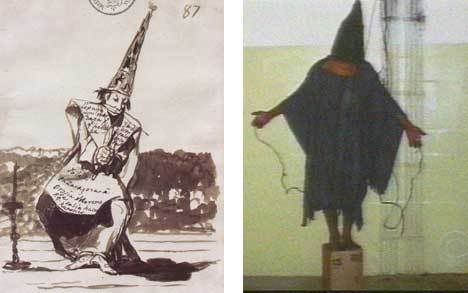
The American 'crusade' into Iraq has proven to be a disaster from the outset to its inevitable end-game which will be a bit like --no, a LOT like - the ignominious exit from Saigon of U.S. troops thiry years ago. The war on terrorism, or, rather, the war on Islamist fanaticism, the clash of civilizations is quite real, and Iraq has added to the enemy's credit, not ours. The *one* thing we might salvage of honor is to help the one non-Arab legitimate national group seeking its own place in the sunlight, the long-suffering Kurdish people. If we ultimately do not abandon our friends and genuine allies the Kurds of "northern Iraq" (see banner below), and simply leave the Iraqis to the barbaric Islamist Civil War they so richly deserve, but *leave*, we will have done well, served American interests well, and done a bit to make up for the farce the Bush administration has foisted upon the American people and military in the shadow of 9/11.

THE SOUND OF DISTANT THUNDER-LAST WORDS ON THE SUBJECT
"They sow the wind
and reap the whirlwind. "
Hosea 8:7
""The Baath party and Baathists still exist in Iraq, and nobody can marginalize it."
Samir al-Obaidi, who attended a Saddam memorial
BITS FROM THE MEDIA - THE DAY AFTER THE LYNCHING OF THE PREVIOUS (SECULAR) DICTATOR BY THE CURRENT ISLAMIST DICTATORSHIP
Report: U.S. Tried To Delay Saddam Hanging
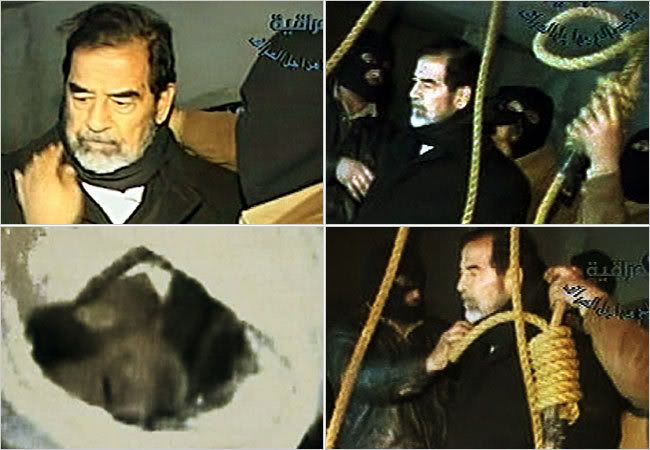
BAGHDAD, Jan. 1, 2007(CBS/AP) In the hours before Saddam Hussein was led to the gallows by men in ski masks, the U.S. ambassador to Iraq reportedly tried, but failed, to delay the execution, reports CBS News correspondent Randall Pinkston.
A Reuters report, quoting Iraqi officials familiar with the discussions, says ambassador Zalmay Khalilzad insisted that Prime Minister Nuri al-Maliki provide certain documents, including a signature from Iraq's president.
Iraq's national security adviser Mowaffak al-Rubaie confirmed to CBS News that the U.S. "brought to the attention of the government of Iraq to be careful with ... documentation" and that Iraq provided the required paperwork including "a consent document from President Jalal Talabani."
The U.S. had leverage. From the moment of his capture, to his trial and sentencing, Saddam was in U.S. military custody, reports Pinkston. After the flurry of negotiations, Saddam wasn't handed over until a few hours before his execution.
After Hussein's burial today, rage over the hanging spilled into the streets in many parts of the Sunni Muslim hartland Monday, especially in Samarra where a mob of angry protesters broke the locks off the badly damaged Shiite Golden Dome mosque and marched through carrying a mock coffin and photo of the executed former leader.
Sunni extremists had blown apart the glistening dome on the Shiite holy place 10 months earlier, setting in motion the sectarian slaughter that now grips the troubled land.
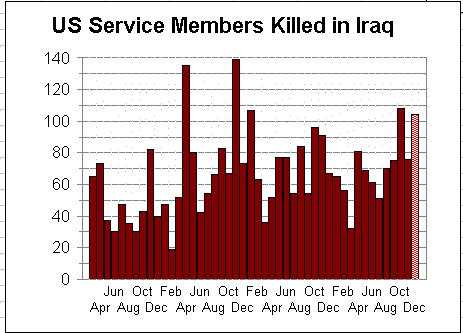
The U.S. death toll climbed to at least 3,002 by the final day of 2006 as the American military reported the deaths of two more soldiers in an explosion Sunday in Diyala Province, northeast of the capital.
The Samarra protest was particularly significant because it signaled a widening expression of defiance among Sunnis, the minority Muslim sect in Iraq that had enjoyed special status and power under Saddam and had oppressed the now-ascendant Shiite majority for centuries.
Until Saddam was executed, excluding a few days of protests after his death sentence was handed down Nov. 5, the broader Sunni population had sought a low profile in the sectarian conflict that had seen thousands of them killed or driven from their homes by Shiite militia forces since the Samarra bombing Feb. 22.
Sunni insurgents and foreign fighters of al-Qaida in Iraq had been conducting a bloody insurgency with attacks on U.S. forces and brutal bombings against Shiite civilians since the summer of 2003, shortly after Saddam was ousted in the American-led invasion.
While many Sunnis were known to be sympathetic to the insurgency, its active membership had not reached broadly into the Sunni population. The angry Sunni protests that now are building in the country could presage deeper involvement by what until now had been a largely quiescent group.
The Sunnis were not only angered by Saddam's hurried execution, just four days after an appeals court upheld his conviction and sentence, but were increasingly incensed by the unruly and undignified manner in which the hanging was carried out.
A clandestine video of the hanging showed Saddam was taunted by some present at the execution with chants of "Muqtada, Muqtada, Muqtada" in the last moments of his life. The chants were a reference to anti-American Shiite cleric Muqtada al-Sadr, who runs one of the deadliest religious militias in Iraq and is a major power behind the government of al-Maliki, who had pushed for Saddam to be hanged before the year was out.
Saddam was put to death on the eve of the Shiite celebration of the Eid al-Ahda, the major Muslim festival marking the end of the hajj pilgrimage to Mecca and a remembrance Abraham's willingness to sacrifice of his son, now symbolized by the slaughtering of sheep.
The first judge in the so-called Dujail trial, Rizgar Mohammed Amin, said Saddam's execution in the during the eid was illegal according to Iraqi law. Sunni Muslim festivities marking the holiday began on the same day that Saddam was hanged. Rizgar, a Kurd, was removed as chief judge in the case after Shiite complaints that he was too lenient. He was replaced in January 2006 by Raouf Rasheed Abdel-Rahman.
"The implementation of Saddam's execution during Eid al-adha is illegal according to chapter 9 of the tribunal law. Article 27 states that nobody, even the president (Jalal Talabani), may change rulings by the tribunal and the implementation of the sentence should not happen until 30 days after publication that the appeals court has upheld the tribunal verdict.
The hanging during the Eid al-Adha period (also) contradicts Iraqi and Islamic custom. "Article 290 of the criminal code of 1971 (which was largely used in the Saddam trial) states that no verdict should implemented during the official holidays or religious festivals," he said.
In northern Baghdad, hundreds of Sunnis conducted a demonstration to mourn Saddam in a predominantly Sunni neighborhood.
"The Baath party and Baathists still exist in Iraq, and nobody can marginalize it," said Samir al-Obaidi, 48, who attended a Saddam memorial in the Azamiyah neighborhood.
In Dor, 77 miles north of Baghdad, hundreds more took to the streets to inaugurate a giant mosaic of Saddam.
Children carried toy guns and men fired into the air. Mourners at a mosque in Saddam's hometown of Tikrit slaughtered sheep as a sacrifice for their former leader. The mosque's walls were lined with condolence cards from tribes in southern Iraq and Jordan who were unable to travel to the memorial.
Saddam's eldest daughter briefly attended a protest Monday in Amman - her first public appearance since her father was hanged.
Raghad Saddam Hussein stopped in at the demonstration staged by the Professional Associations, a body that groups unions for doctors, engineers and lawyers, in its office parking lot in west Amman.
"God bless you, and I thank you for honoring Saddam, the martyr," two witnesses recalled Raghad Saddam Hussein as telling the protesters, who included a junior Cabinet minister, on her arrival. She left a minute later.
Also, U.S. forces killed six people in a raid on the Baghdad offices of a top Sunni politician, Saleh al-Mutlaq, on suspicion it was being used as an al-Qaida safe house, the military and Iraqi police said.
The U.S. military said took on heavy fire from automatic weapons and rocket-propelled grenades as they sought to enter the building. Al-Mutlaq is a senior member of the National Dialogue Front, which holds 11 of the 275 seats in Iraq's parliament.
Police said the raid also took place near the home of Salama al-Khafaji, a former Shiite parliamentarian who abandoned her residence after escaping an assassination attempt last year.
Ground troops were backed by helicopters that "engaged the enemy with precision point target machine gun fire," the military said. It was unclear whether the deaths resulted from the ground assault or fire from U.S. helicopters.
Associated Press Television News footage showed masses of rubble in the area and what appeared to be a long smear of blood where a body had been dragged across the floor of one of the buildings.
Walls in the buildings were pitted with what looked to be the impact of bullets and shrapnel.
With the announced deaths of two more soldiers, the Associated Press count of fatalities showed at least 113 U.S. service members died in December, the bloodiest month of 2006, a year in which at least 822 forces died.
Police reported finding the bodies of 40 handcuffed, blindfolded and bullet-riddled bodies in Baghdad on the first day of the New Year. A police official, who refused to be named out of security fears, said "15 of these bodies found in one place," the largely industrial Sheik Omar district in northern Baghdad.
Otherwise the there were no reported violent deaths in the country Monday with the exception of the shooting death of an Iraqi worker for Algerian Embassy in Baghdad.
Also Monday, the Iraqi government sealed the offices of a privately owned television station, charging it had incited violence and hatred in its programming.
A journalist for Al-Sharqiya station, which broadcasts from Dubai, said the station closed its Baghdad office three months ago because of attacks on its staff.
"The channel administration decided to close it for security reasons," said the journalist, who spoke on condition of anonymity because of safety concerns.
Al-Sharqiya remained on the air late Monday. The station is owned by Saad al-Bazzaz, a one-time chief of radio and television for Saddam.
© MMVII The Associated Press. All Rights Reserved. This material may not be published, broadcast, rewritten, or redistributed.
Sunni anger over Saddam hanging spills into streets
Updated 1/1/2007 7:03 PM ET
BAGHDAD (AP) — Enraged crowds protested the hanging of Saddam Hussein across Iraq's Sunni heartland Monday, as a mob in Samara broke the locks off a bomb-damaged Shiite shrine and marched through carrying a mock coffin and photo of the dictator.
The demonstration in the Golden Dome, shattered in a bombing by Sunni extremists 10 months ago, suggests that many Sunni Arabs may now more actively support the small number of Sunni militants fighting the country's Shiite-dominated government. The Feb. 22 bombing of the shrine triggered the current cycle of retaliatory attacks between Sunnis and Shiia, in the form of daily bombings, kidnappings and murders.
Monday's protest came on a day that saw the U.S. military kill six Iraqis during a raid on the offices of a prominent Sunni political figure, who was suspected of giving al-Qaeda in Iraq fighters sanctuary.
Until Saddam's execution Saturday, most Sunnis sympathized with militants but avoided taking a direct role in the sectarian conflict — despite attacks by Shiite militia that have killed thousands of Sunnis or driven them from their homes. The current Sunni protests, which appear to be building, could signal a spreading militancy.
Sunnis were not only outraged by Saddam's hurried execution, just four days after an appeals court upheld his conviction and sentence. Many were also incensed by the unruly scene in the execution chamber, captured on video, in which Saddam was taunted with chants of "Muqtada, Muqtada, Muqtada."
The chants referred to Muqtada al-Sadr, a firebrand Shiite cleric who runs one of Iraq's most violent religious militias. He is a major power behind the government of Shiite Prime Minister Nouri al-Maliki.
Many Sunnis are also upset that Saddam was put to death the day that Sunni celebrations began for Eid al-Ahda, a major Muslim festival. The judge who first presided over the case that resulted in Saddam's death sentence said the former dictator's execution at the start of Eid was illegal according to Iraqi law, and contradicted Islamic custom.
The law states that "no verdict should implemented during the official holidays or religious festivals," said Judge Rizgar Mohammed Amin, a Kurd.
Rizgar presided over Saddam's trial on charges he killed 148 Shiite men and boys in Dujail, north of Baghdad, in a botched assassination attempt in 1982. The judge was removed from the case after Shiite complaints that he was too lenient.
In a Sunni neighborhood in northern Baghdad, hundreds of demonstrators mourned the executed leader. Some praised the Baath Party, the outlawed nationalist group that under Saddam cemented Sunni Arab dominance of Iraq.
"The Baath party and Baathists still exist in Iraq, and nobody can marginalize it," said Samir al-Obaidi, 48, who attended a Saddam memorial in the Azamiyah neighborhood.
In Dor, 77 miles north of Baghdad, hundreds more took to the streets to attend the dedication of a giant mosaic of Saddam. Children carried toy guns and men fired real weapons into the air.
Mourners at a mosque in Saddam's hometown of Tikrit slaughtered sheep as a sacrifice for their former leader. The mosque's walls were lined with condolence cards from tribes in southern Iraq and Jordan who were unable to travel to the memorial.
Saddam's eldest daughter briefly attended a protest Monday in Jordan — her first public appearance since her father was hanged.
"God bless you, and I thank you for honoring Saddam, the martyr," said Raghad Saddam Hussein, according to two witnesses. She addressed members of the Professional Associations — an umbrella group of unions representing doctors, engineers and lawyers — in the group's office parking lot in west Amman.
In the midst of the protests, U.S. forces continued operations in Iraq.
Six Iraqis were killed in a U.S.-led raid on the Baghdad offices of a top Sunni politician, Saleh al-Mutlaq. The U.S. military and Iraqi police said they suspected the offices were being used as an al-Qaeda safe house.
Al-Mutlaq is a senior member of the National Dialogue Front, which holds 11 of the 275 seats in Iraq's parliament.
U.S. forces said they took on heavy fire from automatic weapons and rocket-propelled grenades as they sought to enter the building. Ground troops were backed by helicopters that "engaged the enemy with precision point target machine gun fire," the military said.
It was unclear whether the deaths resulted from the ground assault or fire from U.S. helicopters.
Associated Press Television News footage showed masses of rubble in the area and what appeared to be a long smear of blood where a body had been dragged across the floor of one of the buildings.
Walls were pitted with what appeared to be bullet and shrapnel holes.
The U.S. death toll, meanwhile, climbed to at least 3,002 by the final day of 2006 as the American military reported the deaths of two more soldiers in an explosion Sunday in Diyala Province, northeast of the capital. With the announcement, the Associated Press count of fatalities showed that at least 113 U.S. service members died in December. That makes it bloodiest month of 2006.
Police reported finding the bodies of 40 handcuffed, blindfolded and bullet-riddled bodies in Baghdad on the first day of the New Year. A police official, who refused to be named out of security fears, said 15 of the bodies were discovered in the mainly industrial Sheik Omar district of northern Baghdad.
An Iraqi worker for the Algerian Embassy in Baghdad was shot to death, police said.
Also Monday, the Iraqi government raided and sealed the offices of a privately owned television station, charging it had incited violence and hatred in its programming. In its coverage of the execution of Saddam over the weekend, a newscaster had worn black mourning clothes.
The satellite television channel Al-Sharqiya, which broadcasts from Dubai, remained on the air late Monday. The station is owned by Saad al-Bazzaz, a one-time chief of radio and television for Saddam.
Copyright 2006 The Associated Press. All rights reserved. This material may not be published, broadcast, rewritten or redistributed.
Find this article at:
http://www.usatoday.com/news/world/iraq/2007-01-01-saddam-protests_x.htm?csp=34
AMERICAN BLOOD ON BUSH'S HANDS
To mark or mourn this grim milestone, here is an E&P summary, based on official sources and the Iraq Coaliton Casualty Count web site, of the death tally so far.
*
Deaths by hostile fire: 2422 80.9%
Non-hostile: 578
Age 18-20: 517 17.2%
Age 21-30: 1813 60.9%
U.S. deaths since Bush said "Bring them on": 2,793
Coalition deaths since first January 2005 Iraqi election: 1,653
Days since invasion: 1,382
Average U.S. deaths per day: 2.36
Average last three months: 3.24
Death by IED attack: 1086 36%
Women killed: 62
White: 74%
Hispanic: 11%
Black: 10%
U.S. Army: 1549 51.9%
U.S. Marine: 755
National Guard and Reserves: 596
U.K. deaths: 127
From other countries: 123
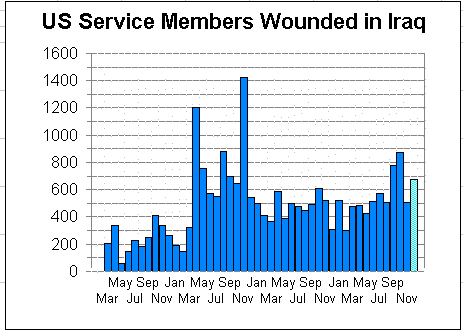
Total wounded: over 22,000
Wounded this year: over 5,600
Estimate of Iraqi deaths since killing of Zarqawi in June 2006: 13,588
Total Iraqi deaths since invasion: 100,000 to 600,000.
U.S. deaths by state:
California 305 10.2%
Texas 266
Pennsylvania 144
New York 139
Ohio 130
Florida 125
Michigan 118
E&P Staff