There are thousands of UFO cases every year. The O'hare Airport case has drawn an unusual amount of media attention. There are lots of cases that have simple expanations. A significant number do not. That doesn't tell you what they are, but this persisting enigma....persists. The media often gets the giggles - as when they talk about sex or God. Make of that what you will. To his credit, Keith Olbermann cover the story as a newsman. Henry_Allen
Tuesday, January 30, 2007


IT LOSES SOMETHING IN TRANSLATION
UNDERSTANDING ARABIC LANGUAGE & CULTURE
FIGHTING FOR THE PERSIAN EMPIRE PART TWO
When U.S. troops fight and die for the "Iraqi Army" they are, in effect, fighting for a Persian Empire (read that "Iranian"), strethching from the borders of India to the Meditarranian Sea. It isn't our war, if it ever was. It is a deperate struggle for the distasteful Sunni Muslim more-or-less secular Arab Nationalism against the Theocractic Islamo-fascism of Iran, and their allies now in control of the Iraqi government we created, the increasingly pro-Iranianian Syrian government, and the terrorist allies of both in Lebanon, the Hezbollah. All of this would never have happened without the U.S. getting involved in a region it doesn't understand, under premises that are either lies or don't apply, in an inept manner that the courage and resourcesfulness of the American Military has been used to fight everybody except the real enemy, the Islamist cells and brainwashing schools spread all across the world. We need to draw-down, protect our allies the Israelis and Kurds, rething, learn proper intelligence and operational tactics in the new world of 'asymetical warfare' -- more accurately termed 4GenWar. Henry_Allen
US and Iraqi forces kill 250 gunmen in day-long battle,
Another U.S. Chopper Down in Sectarian Violence
Michael Howard and Sulamaniya Reuters in Najaf
Monday January 29, 2007
The Guardian
http://www.guardian.co.uk/Iraq/Story/0,,2001081,00.html
US and Iraqi forces killed 250 gunmen in a battle involving US tanks and helicopters on the outskirts of the Shia holy city of Najaf yesterday, a senior Iraqi police officer said.
The day-long battle was continuing after nightfall, Colonel Ali Nomas told Reuters, as tens of thousands of pilgrims converged on the nearby city of Karbala for the climax of the Ashura commemorations, one of the most important days in the Shia calendar. An American helicopter was shot down in the fighting, Iraq security sources said. The US military declined to comment. A Reuters reporter saw a helicopter come down trailing smoke.
Shia political sources said the gunmen appeared to be Sunni Arabs and Shias loyal to a cleric called Ahmed Hassani.
The governor of Najaf province said Iraqi troops fought a day-long battle with up to 200 Sunni gunmen, including foreign fighters, holed up in orchards on the northern outskirts of the city, seat of Iraq's most powerful Shia clerics. Governor Asaad Abu Gilel told Reuters the authorities had uncovered a plot to kill some of the clerics on Monday, to coincide with the climax of Ashura, which occurs today.
A Reuters reporter about a mile from the fighting said he heard intense gunfire and saw US helicopters attack groves sheltering militants. He saw smoke trailing from one helicopter before it came down in the midst of the fighting.
Meanwhile in Baghdad at least four mortar shells struck a girls' secondary school yesterday, killing five pupils and wounding 20.
Witnesses at al-Khaloud school said the shells thudded into the school's yard at about 11am, when many pupils were gathered for a break. Four girls died instantly while a fifth died later in hospital.
"They were just innocently talking to their friends when there was a whistling sound and then deafening blasts," said a parent outside the nearby Yarmouk hospital, where his daughter was being treated for severe leg wounds.
"The mortar rounds shattered the school's windows, spraying glass and shrapnel everywhere," said a police spokesman. He said it was not clear whether the school had been specifically targeted, but it lies in the mainly Sunni district of Adil in western Baghdad.
The area has been the focus of reprisal attacks against Sunni Arabs, following a week of bombings against targets in the east of the city that have killed at least 150 civilians, many of them Shia.
School attendance is down by as much as 60% in some areas amid the general violence in Baghdad and insurgent threats against schools and teachers.
Across the city yesterday another seven people were killed by bombs, while blasts in Falluja and the northern oil city of Kirkuk killed at least 13.
With the war raging in Iraq, America's anti-war movement delivered one of its greatest shows of strength since the invasion in March 2003, when tens of thousands converged on Washington at the weekend to protest against George Bush's decision to send 21,500 more troops to Baghdad and western Anbar province,.
Smaller protests were held in Los Angeles, Seattle, and other US cities.
"Silence is no longer an option," Jane Fonda told the crowd in what she said was her first appearance at an anti-war demonstration since her visit to Hanoi during the Vietnam war. The resulting furore kept her away from such protests for 34 years, she said. "I've been afraid that because of the lies that ... continue to be spread about me and that war that they would be used to hurt this new anti-war movement," she said.
Saturday's protest, organised by a coalition of 1,400 local organisations, straddled the generations of those two wars, with those old enough to remember the tumult of the Vietnam era marching along with younger demonstrators. Protesters arrived by bus from across America, carrying placards reading: "Bush bin lying" and "Civil war accomplished". For the first time since the beginning of the war, the demonstration also included a sizeable contingent of active duty soldiers as well as veterans of the fighting in Iraq. But while there was considerable representation from Hollywood, with Tim Robbins and Susan Sarandon addressing the rally, all but one of the contenders for the Democratic leadership in 2008 stayed away.
Sen. Biden: 'Failed policy' emboldening the enemy
Posted 1/28/2007 12:33 PM ET
USA TODAY
WASHINGTON (AP) — The Senate Foreign Relations Committee chairman on Sunday dismissed criticism a resolution opposing a troop buildup in Iraq would embolden the enemy and estimated perhaps only 20 senators believe President Bush "is headed in the right direction."
"It's not the American people or the U.S. Congress who are emboldening the enemy," said Biden, D-Del., and White House hopeful in 2008. "It's the failed policy of this president — going to war without a strategy, going to war prematurely."
The Senate's top Republican, Mitch McConnell, cast doubt that a clear majority would be able to coalesce behind one of the many competing resolutions on Iraq. "I'm not certain any" will get the necessary votes, he said.
The Democratic-controlled Senate plans to begin debate this week on a non-binding resolution declaring that Bush's proposal to send 21,500 more troops to Baghdad and Anbar province is "not in the national interest."
Last week, Biden's committee approved the measure on a near party-line vote of 12-9.
In reaction, Bush challenged lawmakers not to prematurely condemn his buildup and Vice President Dick Cheney said the administration would proceed even if a non-binding resolution won Senate approval.
With the Senate having just confirmed a new top U.S. commander for Iraq, Defense Secretary Robert Gates said it was "pretty clear that a resolution that in effect says that the general going out to take command of the arena shouldn't have the resources he thinks he needs to be successful certainly emboldens the enemy and our adversaries."
Senate Republicans mostly oppose the committee-passed measure. They are lining up alternatives that express concern about a buildup or in other cases set performance benchmarks for the Iraqi government.
McConnell said Republican leaders would not seek to block a vote on the non-binding resolution with a filibuster. He called a proposed resolution that focuses on benchmarks "the best way to go."
"I think I can pretty well speak for virtually all Republican senators when I say this is the last chance for the Iraqis to step up and do their part," said McConnell, R-Ky.
Biden acknowledged that votes in Congress could splinter among several competing proposals but contended that Senate opposition to the buildup was widespread.
"We will have a full throated debate on this policy," Biden said. "I will make you a bet, you will not find 20% of the Senate standing up and saying the president is headed in the right direction."
Cheney said most Republicans "recognize that what's ultimately going to count here isn't sort of all the hurrah that surrounds these proposals so much as it's what happens on the ground on Iraq. And we're not going to know that for a while yet," according to a Newsweek interview released Sunday.
Cheney again cited "significant progress" in Iraq and said the war is part of a long-term fight against extreme elements of Islam.
"It's not something that's going to end decisively, and there's not going to be a day when we can, say, 'There, now we have a treaty, problem solved,"' Cheney said. "It's a problem that I think will occupy our successors maybe for two or three or four administrations to come."
Sen. Richard Lugar, the top Republican on the Foreign Relations committee, said the public's concern against the war was evident by the tens of thousands of demonstrators who turned out for a protest rally Saturday in Washington.
But he said a congressional resolution would not be constructive, expressing optimism that Lt. Gen. David Petraeus, the new U.S. commander in Iraq, can do a capable job.
"I don't believe that it's helpful right now to show there's disarray around the world as well as in our body at home," said Lugar, R-Ind. "We really need, at this point, to get on the same page."
Biden and Lugar appeared on ABC's This Week and McConnell spoke on Face the Nation on CBS.
Copyright 2007 The Associated Press. All rights reserved. http://www.usatoday.com/news/washington/2007-01-28-biden-iraq_x.htm?csp=34
FIGHTING FOR THE PERSIAN EMPIRE PART TWO
When U.S. troops fight and die for the "Iraqi Army" they are, in effect, fighting for a Persian Empire (read that "Iranian"), strethching from the borders of India to the Meditarranian Sea. It isn't our war, if it ever was. It is a deperate struggle for the distasteful Sunni Muslim more-or-less secular Arab Nationalism against the Theocractic Islamo-fascism of Iran, and their allies now in control of the Iraqi government we created, the increasingly pro-Iranianian Syrian government, and the terrorist allies of both in Lebanon, the Hezbollah. All of this would never have happened without the U.S. getting involved in a region it doesn't understand, under premises that are either lies or don't apply, in an inept manner that the courage and resourcesfulness of the American Military has been used to fight everybody except the real enemy, the Islamist cells and brainwashing schools spread all across the world. We need to draw-down, protect our allies the Israelis and Kurds, rething, learn proper intelligence and operational tactics in the new world of 'asymetical warfare' -- more accurately termed 4GenWar. Henry_Allen
US and Iraqi forces kill 250 gunmen in day-long battle,
Another U.S. Chopper Down in Sectarian Violence
Michael Howard and Sulamaniya Reuters in Najaf
Monday January 29, 2007
The Guardian
http://www.guardian.co.uk/Iraq/Story/0,,2001081,00.html
US and Iraqi forces killed 250 gunmen in a battle involving US tanks and helicopters on the outskirts of the Shia holy city of Najaf yesterday, a senior Iraqi police officer said.
The day-long battle was continuing after nightfall, Colonel Ali Nomas told Reuters, as tens of thousands of pilgrims converged on the nearby city of Karbala for the climax of the Ashura commemorations, one of the most important days in the Shia calendar. An American helicopter was shot down in the fighting, Iraq security sources said. The US military declined to comment. A Reuters reporter saw a helicopter come down trailing smoke.
Shia political sources said the gunmen appeared to be Sunni Arabs and Shias loyal to a cleric called Ahmed Hassani.
The governor of Najaf province said Iraqi troops fought a day-long battle with up to 200 Sunni gunmen, including foreign fighters, holed up in orchards on the northern outskirts of the city, seat of Iraq's most powerful Shia clerics. Governor Asaad Abu Gilel told Reuters the authorities had uncovered a plot to kill some of the clerics on Monday, to coincide with the climax of Ashura, which occurs today.
A Reuters reporter about a mile from the fighting said he heard intense gunfire and saw US helicopters attack groves sheltering militants. He saw smoke trailing from one helicopter before it came down in the midst of the fighting.
Meanwhile in Baghdad at least four mortar shells struck a girls' secondary school yesterday, killing five pupils and wounding 20.
Witnesses at al-Khaloud school said the shells thudded into the school's yard at about 11am, when many pupils were gathered for a break. Four girls died instantly while a fifth died later in hospital.
"They were just innocently talking to their friends when there was a whistling sound and then deafening blasts," said a parent outside the nearby Yarmouk hospital, where his daughter was being treated for severe leg wounds.
"The mortar rounds shattered the school's windows, spraying glass and shrapnel everywhere," said a police spokesman. He said it was not clear whether the school had been specifically targeted, but it lies in the mainly Sunni district of Adil in western Baghdad.
The area has been the focus of reprisal attacks against Sunni Arabs, following a week of bombings against targets in the east of the city that have killed at least 150 civilians, many of them Shia.
School attendance is down by as much as 60% in some areas amid the general violence in Baghdad and insurgent threats against schools and teachers.
Across the city yesterday another seven people were killed by bombs, while blasts in Falluja and the northern oil city of Kirkuk killed at least 13.
With the war raging in Iraq, America's anti-war movement delivered one of its greatest shows of strength since the invasion in March 2003, when tens of thousands converged on Washington at the weekend to protest against George Bush's decision to send 21,500 more troops to Baghdad and western Anbar province,.
Smaller protests were held in Los Angeles, Seattle, and other US cities.
"Silence is no longer an option," Jane Fonda told the crowd in what she said was her first appearance at an anti-war demonstration since her visit to Hanoi during the Vietnam war. The resulting furore kept her away from such protests for 34 years, she said. "I've been afraid that because of the lies that ... continue to be spread about me and that war that they would be used to hurt this new anti-war movement," she said.
Saturday's protest, organised by a coalition of 1,400 local organisations, straddled the generations of those two wars, with those old enough to remember the tumult of the Vietnam era marching along with younger demonstrators. Protesters arrived by bus from across America, carrying placards reading: "Bush bin lying" and "Civil war accomplished". For the first time since the beginning of the war, the demonstration also included a sizeable contingent of active duty soldiers as well as veterans of the fighting in Iraq. But while there was considerable representation from Hollywood, with Tim Robbins and Susan Sarandon addressing the rally, all but one of the contenders for the Democratic leadership in 2008 stayed away.
Sen. Biden: 'Failed policy' emboldening the enemy
Posted 1/28/2007 12:33 PM ET
USA TODAY
WASHINGTON (AP) — The Senate Foreign Relations Committee chairman on Sunday dismissed criticism a resolution opposing a troop buildup in Iraq would embolden the enemy and estimated perhaps only 20 senators believe President Bush "is headed in the right direction."
"It's not the American people or the U.S. Congress who are emboldening the enemy," said Biden, D-Del., and White House hopeful in 2008. "It's the failed policy of this president — going to war without a strategy, going to war prematurely."
The Senate's top Republican, Mitch McConnell, cast doubt that a clear majority would be able to coalesce behind one of the many competing resolutions on Iraq. "I'm not certain any" will get the necessary votes, he said.
The Democratic-controlled Senate plans to begin debate this week on a non-binding resolution declaring that Bush's proposal to send 21,500 more troops to Baghdad and Anbar province is "not in the national interest."
Last week, Biden's committee approved the measure on a near party-line vote of 12-9.
In reaction, Bush challenged lawmakers not to prematurely condemn his buildup and Vice President Dick Cheney said the administration would proceed even if a non-binding resolution won Senate approval.
With the Senate having just confirmed a new top U.S. commander for Iraq, Defense Secretary Robert Gates said it was "pretty clear that a resolution that in effect says that the general going out to take command of the arena shouldn't have the resources he thinks he needs to be successful certainly emboldens the enemy and our adversaries."
Senate Republicans mostly oppose the committee-passed measure. They are lining up alternatives that express concern about a buildup or in other cases set performance benchmarks for the Iraqi government.
McConnell said Republican leaders would not seek to block a vote on the non-binding resolution with a filibuster. He called a proposed resolution that focuses on benchmarks "the best way to go."
"I think I can pretty well speak for virtually all Republican senators when I say this is the last chance for the Iraqis to step up and do their part," said McConnell, R-Ky.
Biden acknowledged that votes in Congress could splinter among several competing proposals but contended that Senate opposition to the buildup was widespread.
"We will have a full throated debate on this policy," Biden said. "I will make you a bet, you will not find 20% of the Senate standing up and saying the president is headed in the right direction."
Cheney said most Republicans "recognize that what's ultimately going to count here isn't sort of all the hurrah that surrounds these proposals so much as it's what happens on the ground on Iraq. And we're not going to know that for a while yet," according to a Newsweek interview released Sunday.
Cheney again cited "significant progress" in Iraq and said the war is part of a long-term fight against extreme elements of Islam.
"It's not something that's going to end decisively, and there's not going to be a day when we can, say, 'There, now we have a treaty, problem solved,"' Cheney said. "It's a problem that I think will occupy our successors maybe for two or three or four administrations to come."
Sen. Richard Lugar, the top Republican on the Foreign Relations committee, said the public's concern against the war was evident by the tens of thousands of demonstrators who turned out for a protest rally Saturday in Washington.
But he said a congressional resolution would not be constructive, expressing optimism that Lt. Gen. David Petraeus, the new U.S. commander in Iraq, can do a capable job.
"I don't believe that it's helpful right now to show there's disarray around the world as well as in our body at home," said Lugar, R-Ind. "We really need, at this point, to get on the same page."
Biden and Lugar appeared on ABC's This Week and McConnell spoke on Face the Nation on CBS.
Copyright 2007 The Associated Press. All rights reserved. http://www.usatoday.com/news/washington/2007-01-28-biden-iraq_x.htm?csp=34
Monday, January 29, 2007
HOMELAND SECURITY - 1950s STYLE
 Ed Murrow has a distinguished career as a journalist, but the Episode of "See It Now" on CBS in 1954 exposing witch-hunter Joe McCarthy was one of his finest hours -- and a warning to all Americans in all eras, including our own, that government witch hunts can happen here, and that it is an ever-present danger to individual liberty and free expression. Henry_Allen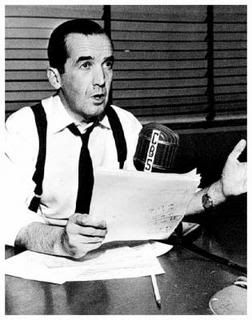

Edward R. Murrow
See it Now (CBS-TV, March 9, 1954)
"A Report on Senator Joseph R. McCarthy"
Murrow: Good evening. Tonight See it Now devotes its entire half hour to a
report on Senator Joseph R. McCarthy told mainly in his own words and pictures.
But first, ALCOA would like you to meet a man who has been with them for fifty
years. (Commercial break.)
Murrow: Because a report on Senator McCarthy is by definition controversial we
want to say exactly what we mean to say and I request your permission to read
from the script whatever remarks Murrow and Friendly may make. If the Senator
believes we have done violence to his words or pictures and desires to speak, to
answer himself, an opportunity will be afforded him on this program. Our working
thesis tonight is this question:
If this fight against Communism is made a fight against America's two great
political parties, the American people know that one of those parties will be
destroyed and the Republic cannot endure very long as a one party system.
We applaud that statement and we think Senator McCarthy ought to. He said it,
seventeen months ago in Milwaukee.
McCarthy: The American people realize this cannot be made a fight between
America's two great political parties. If this fight against Communism is made a
fight between America's two great political parties the American people know
that one of those parties will be destroyed and the Republic cannot endure very
long as a one party system.
Murrow: Thus on February 4th, 1954, Senator McCarthy spoke of one party's
treason. This was at Charleston, West Virginia where there were no cameras
running. It was recorded on tape.
McCarthy: The issue between the Republicans and Democrats is clearly drawn. It
has been deliberately drawn by those who have been in charge of twenty years of
treason. The hard fact is -- the hard fact is that those who wear the label,
those who wear the label Democrat wear it with the stain of a historic betrayal.
Murrow: Seventeen months ago Candidate Eisenhower met Senator McCarthy in Green
Bay, Wisconsin and he laid down the ground rules on how he would meet Communism
if elected.
Eisenhower: This is a pledge I make. If I am charged by you people to be the
responsible head of the Executive Department it will be my initial
responsibility to see that subversion, disloyalty, is kept out of the Executive
Department. We will always appreciate and welcome Congressional investigation
but the responsibility will rest squarely on the shoulders of the Executive and
I hold that there are ample powers in the government to get rid of these people
if the Executive Department is really concerned in doing it. We can do it with
absolute assurance. (Applause.)
This is America's principle: Trial by jury, of the innocent until proved guilty,
and I expect to stand to do it.
Murrow: That same night in Milwaukee, Senator McCarthy stated what he would do
if the General was elected.
McCarthy: I spent about a half hour with the General last night. While I can't
-- while I can't report that we agreed entirely on everything -- I can report
that when I left that meeting with the General, I had the same feeling as when I
went in, and that is that he is a great American, and will make a great
President, an outstanding President. But I want to tell you tonight, tell the
American people as long as I represent you and the rest of the American people
in the Senate, I shall continue to call them as I see them regardless of who
happens to be President.
Murrow: November 24th, 1953.
McCarthy: A few days ago I read that President Eisenhower expressed the hope
that by election time in 1954 the subject of Communism would be a dead and
forgotten issue. The raw, harsh unpleasant fact is that Communism is an issue
and will be an issue in 1954.
Murrow: On one thing the Senator has been consistent... Often operating as a
one-man committee, he has traveled far, interviewed many, terrorized some,
accused civilian and military leaders of the past administration of a great
conspiracy to turn the country over to Communism, investigated and substantially
demoralized the present State Department, made varying charges of espionage at
Fort Manmouth. (The Army says it has been unable to find anything relating to
espionage there.) He has interrogated a varied assortment of what he calls
"Fifth Amendment Communists." Republican Senator Flanders of Vermont said of
McCarthy today:
He dons war paint; he goes into his war dance; he emits his war whoops; he goes
forth to battle and proudly returns with the scalp of a pink Army dentist.
Other critics have accused the Senator of using the bull whip and smear. There
was a time two years ago when the Senator and his friends said he had been
smeared and bull whipped.
Mr. Keefe: You would sometimes think to hear the quartet that call themselves
"Operation Truth" damning Joe McCarthy and resorting to the vilest smears I have
ever heard. Well, this is the answer, and if I could express it in what is in my
heart right now, I would do it in terms of the poet who once said:
Ah 'tis but a dainty flower I bring you,
Yes, 'tis but a violet, glistening with dew,
But still in its heart there lies beauties concealed
So in our heart our love for you lies unrevealed.
McCarthy: You know, I used to pride myself on the idea that I was a bit tough,
especially over the past eighteen or nineteen when we have been kicked around
and bull whipped and damned. I didn't think that I could be touched very deeply.
But tonight, frankly, my cup and my heart is so full I can't talk to you.
Murrow: But in Philadelphia, on Washington's Birthday, 1954, his heart was so
full he could talk. He reviewed some of the General Zwicker testimony and proved
he hadn't abused him.
McCarthy: Nothing is more serious than a traitor to this country in the
Communist conspiracy. Question: Do you think stealing $50 is more serious than
being a traitor to the country and a part of the Communist conspiracy?
Answer: That, sir, was not my decision.
McCarthy: Shall we go on to that for a while? I hate to impose on your time. I
just got two pages. This is the abuse which is... the real meat of abuse, this
is the official reporter's record of the hearing. After he said he wouldn't
remove that General from the Army who cleared Communists, I said: "Then General,
you should be removed from any Command. Any man who has been given the honor of
being promoted to General, and who says, 'I will protect another general who
protects Communists,' is not fit to wear that uniform, General." (Applause.)
I think it is a tremendous disgrace to the Army to have to bring these facts
before the public but I intend to give it to the public, General. I have a duty
to do that. I intend to repeat to the press exactly what you said so that you
can know that and be back here to hear it, General.
And wait till you hear the bleeding hearts scream and cry about our methods of
trying to drag the truth from those who know, or should know, who covered up a
Fifth Amendment Communist Major. But they say, 'Oh, it's all right to uncover
them but don't get rough doing it, McCarthy.'
Murrow: But two days later, Secretary Stevens and the Senator had lunch, agreed
on a memorandum of understanding, and disagreed on what the small type said.
Stevens: I shall never accede to the abuse of Army personnel under any
circumstance including committee hearings. I shall not accede to them being
brow-beaten or humiliated. In the light of these assurances, although I did not
propose cancellation of the hearings, I acceded to it. If it had not been for
these assurances, I would never have entered into any agreement whatsoever.
Murrow: Then President Eisenhower issued a statement that advisers thought
censored the Senator, but the Senator saw it as another victory, called the
entire Zwicker case "a tempest in a teapot."
McCarthy: If a stupid, arrogant or witless man in a position of power appears
before our Committee and is found aiding the Communist Party, he will be
exposed. The fact that he might be a General places him in no special class as
far as I am concerned. Apparently -- apparently, the President and I now agree
on the necessity of getting rid of Communists. We apparently disagree on how we
should handle those who protect Communists. When the shouting and the tumult
dies, the American people and the President will realize that this unprecedented
mud slinging against the Committee by the extreme left wing elements of press
and radio was caused solely because another Fifth Amendment Communist was
finally dug out of the dark recesses and exposed to the public view.
Murrow (points to a chart): Senator McCarthy claims that only the left wing
press criticized him on the Zwicker case. Of the fifty large circulation
newspapers in the country, these are the left wing papers that criticized. These
are the ones which supported him. The ratio is about three to one against the
Senator. Now let us look at some of these left wing papers that criticized the
Senator.
The Chicago Tribune: McCarthy will better serve his cause if he learns to
distinguish the role of investigator from role of avenging angel...
The New York Times: The unwarranted interference of a demagogue -- a domestic
Munich...
The Times Herald, Washington: Senator McCarthy's behavior towards Zwicker is not
justified...
The Herald Tribune of New York: McCarthyism involves assaults on basic
Republican concepts...
Milwaukee Journal: The line must be drawn and defended or McCarthy will become
the government...
The Evening Star of Washington: It was a bad day for everyone who resents and
detests the bully boy tactics which Senator McCarthy often employees...
The New York World Telegram: Bamboozling, bludgeoning, distorting...
St. Louis Post Dispatch: Unscrupulous, McCarthy bullying. What a tragic irony it
is that the President's political advisors keep him from doing what every decent
instinct must be commanding him to do...
Well, that's the ratio of a three-to-one, so-called "left-wing" press.
Another interesting thing was said about the Zwicker case, and it was said by
Senator McCarthy.
McCarthy: Well, may I say that I was extremely shocked when I heard that
Secretary Stevens told two Army officers that they had to take part in the
cover-up of those who promoted and coddled Communists. As I read his statement,
I thought of that quotation "On what meat doth this, our Caesar, feed?"
Murrow: And upon what meat doth Senator McCarthy feed? Two of the staples of his
diet are the investigation (protected by immunity) and the half-truth. We
herewith submit samples of both.
First, the half-truth. This was an attack on Adlai Stevenson at the end of the
1952 campaign. President Eisenhower, it must be said, had no prior knowledge of
it.
McCarthy: I perform this unpleasant task because the American people are
entitled to have the coldly documented history of this man who says, "I want to
be your President."
Strangely, Alger -- I mean, Adlai [laughter] -- But let's move on to another
part of the jigsaw puzzle. Now, while you think -- while you may think there can
be no connection between the debonair Democratic candidate and a dilapidated
Massachusetts barn, I want to show you a picture of this barn and explain the
connection.
Here is the outside of the barn. Give me the pictures of the inside, if you
will. Here is the outside of the barn up at Lee, Massachusetts. It looks as
though it couldn't house a farmer's cow or goat from the outside. Here's the
inside: a beautifully panelled conference room with maps of the Soviet Union.
Well, in what way does Stevenson tie up with that?
My -- my investigators went out and took pictures of the barn after we had been
tipped off of what was in it -- tipped off that there was in this barn all the
missing documents from the Communist front -- IPR -- the IPR which has been
named by the McCarran Committee -- named before the McCarran Committee as a
coverup for Communist espionage.
Now, let's take a look at a photostat of a document taken from the Massachusetts
barn -- one of those documents which was never supposed to see the light of day.
Rather interesting it is. This is a document which shows that Alger Hiss and
Frank Coe recommended Adlai Stevenson to the Mount Tremblant Conference which
was called for the purpose of establishing foreign policy (postwar foreign
policy) in Asia. And, as you know, Alger Hiss is a convicted traitor. Frank Coe
has been named under oath before congressional committees seven times as a
member of the Communist Party. Why? Why do Hiss and Coe find that Adlai
Stevenson is the man they want representing them at this conference? I don't
know. Perhaps Adlai knows.
Murrow: But Senator McCarthy didn't permit his audience to hear the entire
paragraph. This is the official record of the McCarran hearings. Anyone can buy
it for two dollars. Here's a quote: "Another possibility for the Mount Tremblant
conferences on Asia is someone from Knox' office or Stimson's office." (Frank
Knox was our wartime Secretary of the Navy; Henry Stimson our Secretary of the
Army, both distinguished Republicans.) And it goes on: "Coe, and Hiss mentioned
Adlai Stevenson (one of Knox' special assistants) and Harvey Bundy (former
Assistant Secretary of State under Hoover, and now assistant to Stimson) because
of their jobs."
We read from this documented record, not in defense of Mr. Stevenson, but in
defense of truth. Specifically, Mr. Stevenson's identification with that red
barn was no more, no less than that of Knox, Stimson or Bundy. It should be
stated that Mr. Stevenson was once a member of the Institute of Pacific
Relations. But so were such other loyal Americans as Senator Ferguson, John
Foster Dulles, Paul Hoffman, Harry Luce and Herbert Hoover. Their association
carries with it no guilt, and that barn has nothing to do with any of them.
Now -- a sample investigation. The witness was Reed Harris, for many years a
civil servant in the State Department, directing the information service. Harris
was accused of helping the Communistic cause by curtailing some broadcasts to
Israel. Senator McCarthy summoned him and questioned him about a book he had
written in 1932.
McCarthy: Now we'll come to order. Mr. Reed Harris? Your name is Reed Harris?
Harris: That's correct.
McCarthy: You wrote a book in '32, is that correct?
Harris: Yes, I wrote a book. As I testified in executive session...
McCarthy: At the time you wrote the book -- pardon me; go ahead. I'm sorry.
Proceed.
Harris: At the time I wrote the book the atmosphere in the universities of the
United States was greatly affected by the great depression then in existence.
The attitudes of students, the attitudes of the general public were considerably
different than they are at this moment and for one thing there was generally no
awareness, to the degree that there is today, of the way the Communist Party
works.
McCarthy: You attended Columbia University in the early thirties. Is that right?
Harris: I did, Mr. Chairman.
McCarthy: Will you speak a little louder, sir?
Harris: I did, Mr. Chairman.
McCarthy: And were you expelled from Columbia?
Harris: I was suspended from classes on April 1st, 1932. I was later reinstated
and I resigned from the University.
McCarthy: And you resigned from the University? Did the Civil -- Civil Liberties
Union provide you with an attorney at that time?
Harris: I had many offers of attorneys, and one of those was from the American
Civil Liberties Union, yes.
McCarthy: The question is did the Civil Liberties Union supply you with an
attorney?
Harris: They did supply an attorney.
McCarthy: The answer is yes?
Harris: The answer is yes.
McCarthy: You know the Civil Liberties Union has been listed as "a front for,
and doing the work of," the Communist Party?
Harris: Mr. Chairman this was 1932.
McCarthy: Yeah, I know it was 1932. Do you know that they since have been listed
as "a front for, and doing the work of" the Communist Party?
Harris: I do not know that they have been listed so, sir.
McCarthy: You don't know they have been listed?
Harris: I have heard that mentioned or read that mentioned.
McCarthy: Now, you wrote a book in 1932. I'm going to ask you again: at the time
you wrote this book, did you feel that professors should be given the right to
teach sophomores that marriage -- and I quote -- "should be cast out of our
civilization as antiquated and stupid religious phenomena?" Was that your
feeling at that time?
Harris: My feeling is that professors should have the right to express their
considered opinions on any subject, whatever they were, sir.
McCarthy: All right, I'm going to ask you this question again.
Harris: That includes that quotation. They should have the right to teach
anything that came into their minds as being the proper thing to teach.
McCarthy: I'm going to make you answer this.
Harris: All right, I'll answer yes, but you put an implication on it and you
feature this particular point of the book, which, of course, is quite out of
context, does not give a proper impression of the book as a whole. The American
public doesn't get an honest impression of even that book, bad as it is, from
what you are quoting from it.
McCarthy: Well, then, let's continue to read your own writing, and...
Harris: Twenty-one years ago, again.
McCarthy: Yes, but we shall try and bring you down to date, if we can.
Harris: Mr. Chairman, two weeks ago, Senator Taft took the position that I took
twenty-one years ago, that Communists and Socialists should be allowed to teach
in the schools. It so happens that, nowadays I don't agree with Senator Taft, as
far as Communist teaching in the schools is concerned, because I think
Communists are, in effect, a plainclothes auxiliary of the Red Army, the Soviet
Red Army. And I don't want to see them in any of our schools, teaching.
McCarthy: I don't recall Senator Taft ever having any of the background that
you've got, sir.
Harris: I resent the tone of this inquiry very much, Mr. Chairman. I resent it,
not only because it is my neck, my public neck, that you are, I think, very
skillfully trying to wring, but I say it because there are thousands of able and
loyal employees in the federal government of the United States who have been
properly cleared according to the laws and the security practices of their
agencies, as I was -- unless the new regime says no; I was before.
McClellan: Do you think this book did considerable harm, its publication might
have had adverse influence on the public by an expression of views contained in
it?
Harris: The sale of that book was so abysmally small. It was so unsuccessful
that a question of its influence... Really, you can go back to the publisher.
You'll see it was one of the most unsuccessful books he ever put out. He's still
sorry about it, just as I am.
McClellen: Well, I think that's a compliment to American intelligence...
(Laughter). I will say that for him.
Murrow: Senator McCarthy succeeded in proving that Reed Harris had once written
a bad book, which the American people had proved twenty-two years ago by not
buying it, which is what they eventually do will all bad ideas. As for Reed
Harris, his resignation was accepted a month later with a letter of
commendation. McCarthy claimed it as a victory.
The Reed Harris hearing demonstrates one of the Senator's techniques. Twice he
said the American Civil Liberties Union was listed as a subversive front. The
Attorney General's list does not and has never listed the ACLU as subversive,
nor does the FBI or any other federal government agency. And the American Civil
Liberties Union holds in its files letters of commendation from President
Truman, President Eisenhower, and General MacArthur.
Now let us try to bring the McCarthy story a little more up to date. Two years
ago Senator Benton of Connecticut accused McCarthy of apparent perjury,
unethical practice, and perpetrating a hoax on the Senate. McCarthy sued for two
million dollars. Last week he dropped the case, saying no one could be found who
believed Benton's story. Several volunteers have come forward saying they
believe it in its entirety.
Today Senator McCarthy says he's going to get a lawyer and force the networks to
give him time to reply to Adlai Stevenson's speech.
Earlier, the Senator asked, "Upon what meat does this, our Caesar, feed?" Had he
looked three lines earlier in Shakespeare's Caesar, he would have found this
line, which is not altogether inappropriate: "The fault, dear Brutus, is not in
our stars, but in ourselves."
No one familiar with the history of this country can deny that congressional
committees are useful. It is necessary to investigate before legislating, but
the line between investigating and persecuting is a very fine one and the junior
Senator from Wisconsin has stepped over it repeatedly. His primary achievement
has been in confusing the public mind, as between internal and the external
threats of Communism. We must not confuse dissent with disloyalty. We must
remember always that accusation is not proof and that conviction depends upon
evidence and due process of law. We will not walk in fear, one of another. We
will not be driven by fear into an age of unreason, if we dig deep in our
history and our doctrine, and remember that we are not descended from fearful
men -- not from men who feared to write, to speak, to associate and to defend
causes that were, for the moment, unpopular.
This is no time for men who oppose Senator McCarthy's methods to keep silent, or
for those who approve. We can deny our heritage and our history, but we cannot
escape responsibility for the result. There is no way for a citizen of a
republic to abdicate his responsibilities. As a nation we have come into our
full inheritance at a tender age. We proclaim ourselves, as indeed we are, the
defenders of freedom, wherever it continues to exist in the world, but we cannot
defend freedom abroad by deserting it at home.
The actions of the junior Senator from Wisconsin have caused alarm and dismay
amongst our allies abroad, and given considerable comfort to our enemies. And
whose fault is that? Not really his. He didn't create this situation of fear; he
merely exploited it -- and rather successfully. Cassius was right. "The fault,
dear Brutus, is not in our stars, but in ourselves."
Good night, and good luck.
Saturday, January 27, 2007
JACK ABOUT URGENCY OF IRAQ PROTEST
LEFT WING ANTI-SEMITISM GUTS TURN OUT AT ANTIWAR RALLIES
from http://motnews.blogspot.com/2007/01/sf-conference-on-anti-semitism-of-left.html via NEWS FOR MEMBERS OF THE TRIBE.
Let's get real, folks, in the Labor Movement, the Civil Rights Movement, the Movement Against the Viet Nam War, and most progressive causes, American Jews have participated actively far out of their proportion to their numbers in the general American population. The unpopular Iraq War has drawn only a fraction of the activists in other such progressive causes, largely because of its glaring support of thinly veiled anti-semitic involvement on the pretext of linking "Palestine" to the issue of Iraq. This should concern not only Jewish Americans (most of whom are progressives of one sort or another), but those who want to effectively oppose the Iraq War without diminishing it with those who want to create a Second Holocaust. Henry_Allen
‘Progressive’ anti-Semitism?
S.F. meet considers phenomenon
By Ben Harris
NEW YORK, Jan. 23 (JTA) — Three years ago, Jonathan Bernstein received an e-mail from a distraught political activist in the San Francisco Bay Area concerned about rising anti-Semitism among fellow political progressives.
“The growing acceptance of anti-Semitic rhetoric is so commonplace it is not even recognized as anti-Semitism,” wrote the activist, who went on to list a number of anti-Semitic incidents in her community that had left her rattled.
Despite her opposition to the U.S.-led war in Iraq, the woman had not attended a recent anti-war rally due to her reluctance to support the group organizing the protest.
“We’ve gotten calls for help like that almost weekly here for the last three years,” said Bernstein, director of the Anti-Defamation League office in San Francisco. “With each case we’ve helped put out fires by trying to get the right person to speak out about whatever the issue is.”
On Jan. 28 the ADL will try to do more than just douse fires when it convenes Finding Our Voice, a daylong conference in San Francisco aimed at empowering Jewish progressives to respond to anti-Semitism on the left.
Co-sponsored by more than 50 Jewish organizations from across the political spectrum — including the ADL, the American-Israel Public Affairs Committee, Americans for Peace Now and the Jewish Labor Committee — the conference aims to empower participants to respond to what organizers describe as an alarming trend.
Workshops will feature presentations by university professors, community activists, elected officials and religious leaders. Among the titles are “That’s Not Funny: Cartoons and Editorials — What’s Legitimate and What Isn’t”; Opposing the War While Opposing Anti-Semitism”; “Breaking Through the Myth of Jewish Whiteness”; and “Using Positive Messages to Challenge Hate: Advocacy on the Campus.”
The keynote address will be presented by Anthony Julius, a British Jewish attorney who successfully defended Emory University Professor Deborah Lipstadt in the libel suit brought by Holocaust denier David Irving.
While much attention has been paid to the so-called “new anti-Semitism,” in which antipathy toward Jews is masked as rabid criticism of Israel, the Finding Our Voice conference represents the first organized effort by liberal Jews to fight back.
A similar effort organized by non-Jews, Facing the Challenge Within, was launched in the Bay Area in 2004.
“Right now it seems that the best way to further progressive causes, and particularly a broader sense of how Jews can be active in peace causes, is to give progressive Jews the tools to constructively address anti-Semitism when it comes up in progressive circles,” said Rabbi Jane Litman, a Reform rabbi in Berkeley, Calif.
A lifelong progressive, Litman received death threats during Israel’s war last summer against Hezbollah in Lebanon. An exhibition dealing with the Israeli-Palestinian conflict at a public arts center across the street from her synagogue included images Litman considered hateful, leading her to organize a counter-exhibition to show alternate, peace-oriented images.
“The progressive movement is about tolerance and justice and peace,” Litman said. “It seems so strange that hatefulness can have a home there.”
The left’s tolerance for anti-Jewish bigotry is considered strange by many progressive Jews in the Bay Area, who noticed a marked increase in anti-Semitic rhetoric following the U.S. invasion of Iraq.
Several anti-war protests in San Francisco organized by the ANSWER Coalition featured imagery and slogans some considered anti-Semitic, including the burning of the Israeli flag, chants of support for terrorist groups like Hezbollah and Nazi-like arm salutes.
Conference participants say that while some of this activity reflects a sinister political agenda, much of it stems from ignorance of the complexity of the Middle East conflict.
Some say a tendency to project familiar tropes of imperialist aggression or American racial politics onto the conflict produces a simplistic narrative in which Jews are the “white” oppressors and Palestinians the “black” victims.
Julius calls the ignorance thesis “a touch naive,” believing instead that the problem stems from the failure of the socialist revolution and the search by disaffected leftists for a new cause.
“The 1967 war coincided with the collapse of the socialist project in Europe, and particularly in Eastern Europe,” Julius told JTA. “And anti-Zionism in a way comes out of that collapse, out of a kind of sense of hopelessness of the project of human liberation. Anti-Zionism was the consolation prize to the defeated, disappointed socialists.”
Similarly, just as the anti-war movement has brought together anti-Israel groups with dejected socialists, the conference on anti-Semitism is uniting groups of varying political persuasions — a sign of broad community support for the project, but also a challenge for the organizers.
Some Jews on the left view groups like the ADL and AIPAC with skepticism, believing they deliberately blur the line between anti-Semitism and legitimate criticism of Israeli policy. Others are staying away from the conference out of fear that association with it could cost them credibility in the progressive community.
“We’ve all had to break out of our comfort zones to put this together, including myself,” Bernstein said.
But for some, the ADL hasn’t broken out enough.
Two prominent Bay Area Jewish organizations active in the progressive movement — Tikkun and Jewish Voice for Peace — were not invited to co-sponsor the conference. Two others were invited to participate but declined, citing concerns about the agenda.
Rabbi Michael Lerner, the founder of Tikkun and perhaps the most well-known Jewish progressive in the country, will be in Washington on the day of the conference protesting the Iraq war.
A spokesperson for Jewish Voice for Peace, a liberal advocacy group working on the Israeli-Palestinian conflict, said: “From our perspective, you cannot get to the roots of anti-Semitism in the progressive movement without honestly addressing the severe human-rights violations that Israel engages in every day. Judging by the lineup, that kind of honest examination is not likely to happen at this conference.”
A source involved in planning the conference told JTA that it was precisely that type of discussion that organizers wanted to avoid out of concern that it would distract from the primary focus on Jewish oppression.
Certain groups were eliminated because their personalities might overshadow the conference, the source said.
“We were really trying to get a cross-section of the Jewish community there, and to do that we needed to be a little bit smart about who we invited,” Bernstein said. “I’m hopeful that once we get talking with each other and open up some channels of communication, then that umbrella can broaden and we’ll be able to pull every group in.”
thanks to-
http://motnews.blogspot.com/
Friday, January 26, 2007
Stan Getz in Montreux
Jazz greats like Stan Getz will be featured here now and then, because they are sooo cool.
Henry_Allen
More Getz later
Thursday, January 25, 2007
JOHN PIKE, KEY EXPERT ON SECURITY
John Pike, of Global Security (http://www.globalsecurity.org/) is an old friend and advanced thinker on critical areas of global security and terrorism. We have worked with him for years, and rely on him for information.
In an age when intelligence is not always intelligent, Western Civilization really needs to be consulting with the few people like John Pike that really have a handle on The New post-9/11 Reality.
Henry_Allen
A STATE OF DISUNION

I don’t agree with every word of this analysis – I do feel that there is a fundamental clash of civilizations beginning with the Islamic Revolution in
. Henry_Allen
Bush's War on the Republic
From the beginning of the “war on terror,” George W. Bush has lied to the American people about the goals, motivation and even the identity of the enemy – a propaganda exercise that continued through his 2007 State of the Union Address and that is sounding the death knell for the Republic.
Since 2001, rather than focusing on the al-Qaeda Sunni fundamentalist terrorists behind the 9/11 attacks, Bush has expanded the conflict exponentially – tossing in unrelated enemies such as
In effect, Bush has transformed what began as a definable military objective – the defeat of “terrorist groups with global reach” – into an endless war against what he regards as evil, a conflict so vague that it is claiming as collateral damage
In Bush’s State of the
“The evil that inspired and rejoiced in 9/11 is still at work in the world. And so long as that’s the case,
But that “evil” will always be “at work in the world,” so
Bluntly put, Bush and his neoconservative legal advisers don't believe in the “unalienable rights” guaranteed by the U.S. Constitution, including ones as fundamental as the habeas corpus right to a fair trial and protections against warrantless searches and seizures. [See, for instance, Consortiumnews.com's "Gonzales Questions Habeas Corpus."]
The Bush administration may make grudging concessions in these areas when faced with determined opposition in the courts or from the public, but they hold these liberties to be subordinate to Bush’s “plenary” – or unlimited – powers as Commander in Chief.
Beyond this disdain for fundamental American liberties, Bush has contempt for any meaningful public debate. Though he talks about compromise and consultation, his view of national unity is to have everyone shut up and get in line behind him, "the Decider."
Since the 9/11 attacks, Bush has overseen a bare-knuckled political strategy of bullying anyone who disagrees with him and marginalizing their voices. From the Dixie Chicks to former Ambassador Joseph Wilson, from
These ugly attacks have become so much a part of the American political landscape that the news media treats them as unexceptional, as if it’s normal for a President to coordinate with powerful media allies to silence dissent.
For instance, there was no media outcry in April 2003 when Bush gave a wink and a nod to a retaliatory boycott against the three-woman Dixie Chicks band because the lead singer, Natalie Maines, had criticized the President.
“They shouldn’t have their feelings hurt just because some people don’t want to buy their records when they speak out,” Bush said. “Freedom is a two-way street.”
So, instead of encouraging a full-and-free debate about an issue as important as war and peace, Bush made clear that he saw nothing wrong with his followers punishing Americans who disagree with him.
'Democrat Party'
While Bush may have softened his belligerent style slightly since the Republican defeat in the November 2006 elections, he still couldn’t muster enough politeness to refer to the “Democratic” Party in his State of the
For years, tough-talking Republicans have made it a point of insult to drop the “-ic” and use “Democrat” as the adjective. This phrasing has become a mark of the swaggering Republicans who have dominated this era of
So, even as Bush was supposedly trying to be gracious to House Speaker Nancy Pelosi, he couldn’t stop himself from congratulating the “Democrat majority.”
More significantly, however, Bush continues to demean the Constitution. Despite having sworn “to preserve, defend and uphold the Constitution” as his preeminent duty, Bush keeps insisting that the highest obligation of government is to keep the people safe.
He repeated that mantra in his State of the
In other words, Bush believes security – or at least his view of security – trumps everything, including constitutional rights.
But that concept turns upside down more than two centuries of
Bush apparently sees the American people as a pudgy bunch of consumers as soft in the head as in their bellies. In the State of the
To heighten the fears of Americans, he again misrepresented the goals, capabilities and even the identities of the enemy. He blurred diverse and even antagonistic Muslim Sunni and Shiite groups, shoving them under the umbrella of “the Islamist radical movement.”
“The Shia and Sunni extremists are different faces of the same totalitarian threat,” Bush said. “Whatever slogans they chant, when they slaughter the innocent they have the same wicked purposes. They want to kill Americans, kill democracy in the
But this depiction is a continuation of Bush's tendency to misstate the key question of what's motivating Islamic militancy.
In September 2001, Bush claimed that the motive behind the 9/11 attacks and other manifestations of anti-Americanism in the
However, this distortion of what drives the swelling anti-Americanism in the
Diverse Motives
The truth is that the motives of Islamic militants are much more complicated and diverse than Bush wants the American people to know.
In
Some Middle Eastern militants are resentful of U.S.-backed autocrats like those governing
In the Palestinian territories, Hamas did win an election. In
Even al-Qaeda has far more limited objectives than Bush has claimed. Despite Bush’s oft-stated assertion that – if the
Intercepted al-Qaeda documents actually reveal leaders fretting about how fragile their position in
“Indeed, prolonging the war is in our interest,” Atiyah wrote. [For details, see Consortiumnews.com’s “Al-Qaeda’s Fragile Foothold.”]
Yet, even as Bush's Iraq War strategy plays into the hands of al-Qaeda, the President told Congress and the American people that he intends to confront radical Shiite movements in the region with determination equal to that aimed at Sunni extremists. Bush said:
“In recent times, it has also become clear that we face an escalating danger from Shia extremists who are just as hostile to
But Bush left out the history about those American deaths. He was referring primarily to the 241
By definition, terrorism is a violent attack on civilians to achieve a political end. Hezbollah’s attack in 1983, therefore, was not an act of terrorism as lamentable as the military deaths were. Bush, however, blurs the point by associating the bombing with al-Qaeda’s 9/11 attacks on civilian targets inside the
Although the
Guaranteeing Defeat
Lumping
Bush also finds himself caught in a contradiction between his rhetorical embrace of
At one point in his State of the Union speech, Bush denounced extremists who seek to “overthrow moderate governments” but returned to his lofty rhetoric about democracy and freedom as vital components in defeating the extremists.
“To prevail, we must remove the conditions that inspire blind hatred,” Bush said. “What every terrorist fears most is human freedom. … The great question of our day is whether
Though a surefire applause line, Bush’s praise of liberty represents possibly the most insidious lie from his "war on terror." As
As was obvious during Secretary of State Condoleezza Rice’s trip to the
Bush’s exhortations about human freedom therefore are galling to many in the world who see Bush himself as the world’s most notorious autocrat, violating international law at his personal whim and overriding the constitutional liberties of Americans at home.
Bush is the personification of what recent polls of global opinion have registered as a leading complaint about
There is also no end in sight, Bush made clear.
“The war on terror we fight today is a generational struggle that will continue long after you and I have turned our duties over to others,” Bush told Congress. “And that’s why it’s important to work together so our nation can see this great effort through.”
But the bottom line for Bush’s “war on terror” is that it won't just cost countless lives and hundreds of billions of dollars; it also is doomed to fail, at least as presently constituted. If it lasts much longer, it is certain, too, to deliver a death blow to the noble
Robert Parry broke many of the Iran-Contra stories in the 1980s for the Associated Press and Newsweek. His latest book, Secrecy & Privilege: Rise of the Bush Dynasty from Watergate to Iraq, can be ordered at secrecyandprivilege.com. It's also available at Amazon.com, as is his 1999 book, Lost History: Contras, Cocaine, the Press & 'Project Truth.'
To comment at Consortiumblog, click here. To comment to us by e-mail, click here. To donate so we can continue reporting and publishing stories like the one you just read, click here.
Subscribe to:
Posts (Atom)